New Book on Lying and Homosexual Activity

John Skalko has published a book, Disordered Actions: A Moral Analysis of Lying and Homosexual Activity.

https://www.amazon.com/Disordered-Actions-Analysis-Homosexual-Activity/dp/3868382186/ref=sr_1_1?keywords=disordered+actions&qid=1563825462&s=books&sr=1-1

There is to the best of my knowledge no previous scholarly book-length defense of Aquinas on homosexuality.  Prior to the publication of Skalko’'s work, you only had Gareth Moore and Adriano Oliva, both Dominicans, who either attacked or reinterpreted Aquinas. I reviewed Oliva’s work for The Thomist, and it seemed to me either incompetent or dishonest.

"Apostle to the Apostles"

Titian, Noli me tangere, 16th century

Three years ago, Pope Francis elevated the July 22 liturgical memorial of St. Mary Magdalene to the dignity of a feast day to be celebrated universally throughout the Church on par with feasts of the apostles. He also gifted the great saint with the title of “Apostle to the Apostles,” an ancient designation first tokened in part by St. Thomas Aquinas himself. In his Lectura super Ioannis, we find this passage in caput 20, lectio 3:

“Note the three privileges given to Mary Magdalene. First, she had the privilege of being a prophet because she was worthy enough to see the angels, for a prophet is an intermediary between angels and the people. Second, she had the dignity or rank of an angel insofar as she looked upon Christ, on whom the angels desire to look. Third, she had the office of an apostle; indeed, she was an apostle to the apostles insofar as it was her task to announce our Lord’s resurrection to the disciples. Thus, just as it was a woman who was the first to announce the words of death, so it was a woman who would be the first to announce the words of life.” (2519)

Aquinas affords a triple dignity to Mary Magdalene, the first disciple to bear witness to the resurrected Jesus Christ: she is a prophetess, an angelic messenger, and an apostolic figure. As a witness to the resurrection and as a bearer of the glad tidings from the resurrected Christ, Mary is portrayed by St. John as an apostle commissioned by Jesus himself to the apostles. It should not surprise us that the Common Doctor picks up on this archetypal role filled by the Magdalene.

On this universal feast of the Church, let us give thanks to God for the evangelical witness of St. Mary Magdalene who “first announce[d] the words of life,” and for our indebtedness to St. Thomas Aquinas for naming her “apostle to the apostles.”

With thanks to Rev. John Ubel for the inspiration for this post.

The Love of God Poured Out: Grace and the Gifts of the Holy Spirit in St. Thomas Aquinas

John M. Meinert offers a signal contribution to contemporary scholarship on the gifts of the Holy Spirit in The Love of God Poured Out: Grace and the Gifts of the Holy Spirit in St. Thomas Aquinas. St. Thomas composed his Summa theologiae as a unified presentation of sacra doctrina, and Meinert uncovers the riches of reading the treatise on grace in the Summa alongside the treatise on the gifts.

Servais Pinckaers argued that that the gifts of the Holy Spirit exert a perpetual and pervasive influence on the Christian moral life, contrary to the more traditional reading of Aquinas that the gifts are only intermittently activated by a distinct grade of supernatural inspirations. Meinert gives greater traction to Pinckaers’s interpretation by arguing in various ways that the instinctus of the Holy Spirit is in fact identical with the common auxilium that God gives to believers, i.e. actual grace. From this central thesis, Meinert offers an impressive number of implications for Thomistic thought on the modes of human action, sacramental grace, merit, perseverance, the divisions of grace, the relations between grace, gifts, and virtues, etc. The book also contains some handy expositions of St. Thomas’s analogous uses of the terms instinctus, auxilium, necessity, and motion. Meinert offers a highly credible alternative to the traditional reading of St. Thomas on the gifts. His project, however, would be helpfully supplemented with a more thorough account of the context in which St. Thomas developed his theology of the gifts as well as the formation of the traditional consensus about their unique mode of operation. I suspect that investigating these contexts will give conclusive evidence that Meinert has in fact struck key insights in St. Thomas’s thought.

The Love of God Poured Out is highly technical and would not be suitable for anyone who is not already familiar with St. Thomas’s treatments of both grace and the gifts. That said, for anyone with a serious scholarly interest in the gifts of the Holy Spirit, this book is simply indispensable.

- Reviewed by Joshua Revelle, The Catholic University of America

Leonard E. Boyle O.P.

Boyle Leonard E. (1923-1999).jpg

On the 25th of October 2019, the Thomistic community will commemorate the 20th anniversary of the death of father Leonard  E. Boyle O.P. (1923-1999) who taught for many years at the Pontifical Institute of Mediaeval Studies (before becoming Prefect of the Vatican Library in 1984) and as such had a formative influence on an entire generation of Thomists. His most important publications on Thomas were collected in Facing History: A Different Thomas Aquinas (Louvain-la-Neuve: FIDEM, 2000). His enduring scientific legacy for the Thomistic community centers in my modest view around two novel contributions. First, the historical situatedness of Thomas’ moral thought, in particular within the Dominican educational context of the 13th century, a topic which he developed from a much wider perspective as well (see his collection Pastoral Care, Clerical Education and Canon Law, 1200-1400, London: Variorum Reprints, 1981 and in particular his “Notes on the Education of the Fratres Communes in the Dominican Order in the Thirteenth Century”). Understanding the mindset of Thomas’s most influential contribution, the Summa theologiae and in particular the novelty of the Secunda pars requires taking into account father Boyle’s work and its continuation by J.-P. Torrell, M. Michele Mulcahey and others. His second contribution concerns the notorious alia lectura fratris Thome, that is to say, a set of marginal annotations in the Oxford manuscript Lincoln College lat. 95. In his 1980 article, which reads like a thrilling detective’s quest, father Boyle turns father Hyacinth Dondaine’s arguments around and concludes in favor of the authenticity of these marginal notes. The notes in their entirety were finally published by John P. Boyle as Lectura romana in primam Sententiarum Petri Lombardi (Toronto: PIMS, 2006). The debate that followed this edition, both regarding the authenticity of the content of the notes as well as the attribution of the different hands, remains ongoing but in any case testifies to the ingenuity of father Boyle and the importance of returning to the manuscripts. (A brief survey of the discussion can be found in Torrell’s new edition of his Initation à saint Thomas d’Aquin. Sa personne et son oeuvre (Paris: Cerf, 2015, 73-77).

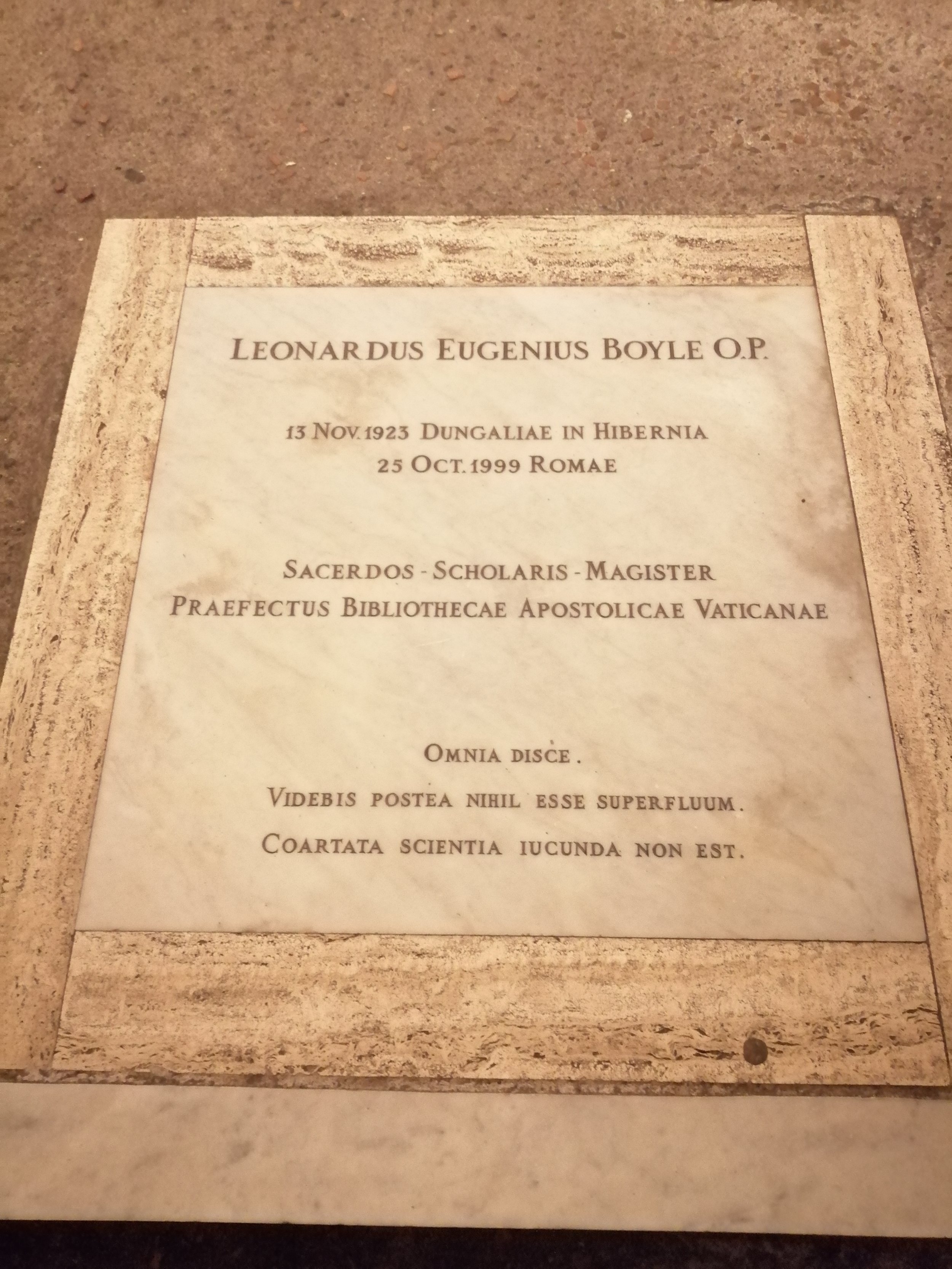
Father Boyle, who both as an Irish Dominican and an as historian of the Order’s achievements, took a particular interest in the church of San Clemente in Rome. This 12th century church, which has been in the care of the Irish Dominicans since 1667, is in reality a three-tiered complex of buildings. The present church is built upon a 4th century basilica which in turn is built upon a pagan temple for the worship of Mithras. During the recent Symposium Thomisticum IV, held in Rome, we were given a tour of the complex and it is there where I was able, at the level of the 4th century basilica, to take this picture of the tomb of father Boyle. R.I.P.

Boyle Tomb San Clemente.jpg
1 Comment

Jörgen Vijgen

DR. JÖRGEN VIJGEN holds academic appointments in Medieval and Thomistic Philosophy at several institutions in the Netherlands. His dissertation, “The status of Eucharistic accidents ‘sine subiecto’: An Historical Trajectory up to Thomas Aquinas and selected reactions,” was written under the direction of Fr. Walter Senner, O.P. at the Pontifical University of St. Thomas Aquinas (Angelicum) in Rome, Italy and published in 2013 by Akademie Verlag (now De Gruyter) in Berlin, Germany.

On Reading Thomas

Thomas is always a joy to read. An ordering of the mind. A judicious approach, multifaceted and subtle yet not tangled and unruly.

Now and again, one tastes a bit of the angelic. Things in the world recede in their tumbling chaos. Not, mind you, to the loss of their detail. But their real being, their weight, and their true finality appears through the din of what would otherwise, deafening me, make lame my mind’s eye so that I could not feel all their stuff. Now and again, one of Thomas’s insights gathers one on high to taste this angelic stance, at once very human.

So it was, this morning, in reading his ‘On Judgment.’ Who would have thought, before turning these pages, that judgment is an act of justice? Not I. Often, Thomas is intuitive. Not this time. At any rate, he goes on to cite Aristotle: People seek refuge in a judge, as in a sort of living justice. (And so, this time, the insight is Aristotle’s. But who owns an idea anyway? We are all in the school. It is habits of mind, not ownership; truth, not persons, for which we are most eager.)

Reading this peculiar passage brought a recollection of things past: children’s voices raised in animosity. A dispute. An argument. Recourse! Recourse to whom? To a third party. To Mom or Dad. All those times that seemed so wearisome, so bothersome, …. All these now gathered together in the insight: people seek refuge in a judge. Why? They want a right saying. How consoling to read the Master and to have meaning found where one saw only chaos.

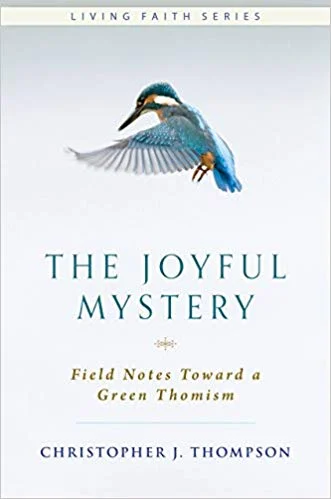
The Joyful Mystery: Field Notes toward a Green Thomism

Joyful Mystery.jpg

Christopher J. Thompson’s first publication formally introducing his “Green Thomism” is a work of art. For years, Thompson has been quietly coordinating this Thomistic vision for ecology through his Chapelstone Foundation and with a number of articles calling for theologians and other thinkers to give serious moral consideration to the intersection of the Catholic worldview and the growing need for ecological stewardship. Now, he weaves together an integral account that convincingly presents our contemporary deficit with regard to the natural order of lower creation and also argues for a proper vision rooted in the Thomistic philosophical and theological tradition. Throughout, Thompson relies upon the doctrine of Pope Francis’s Laudato Si’, beautifully demonstrating the Thomistic precedent in the holy father’s encyclical.

thompson 2.jpg

The Joyful Mystery: Field Notes toward a Green Thomism is available from Emmaus Road Publishing in their Living Faith Series as a small, easy-to-read and easy-to-enjoy hardback. It is accessible at a popular level to readers who have some familiarity with the Catholic Thomistic tradition. Just because it is accessible, however, does not mean that it is not intellectually worthwhile. Its import primarily lies, however, in its ability to personally challenge the reader to convert their minds and hearts and habits to Jesus Christ, the Logos Incarnate, the same sapiential Logos who both creates and redeems in a joyful mystery, summoning a proper response of awe and adoration from us rational animals.

- Reviewed by Brandon L. Wanless

Latin-English Opera Omnia of St. Thomas Aquinas

9781623400149-uk.jpg

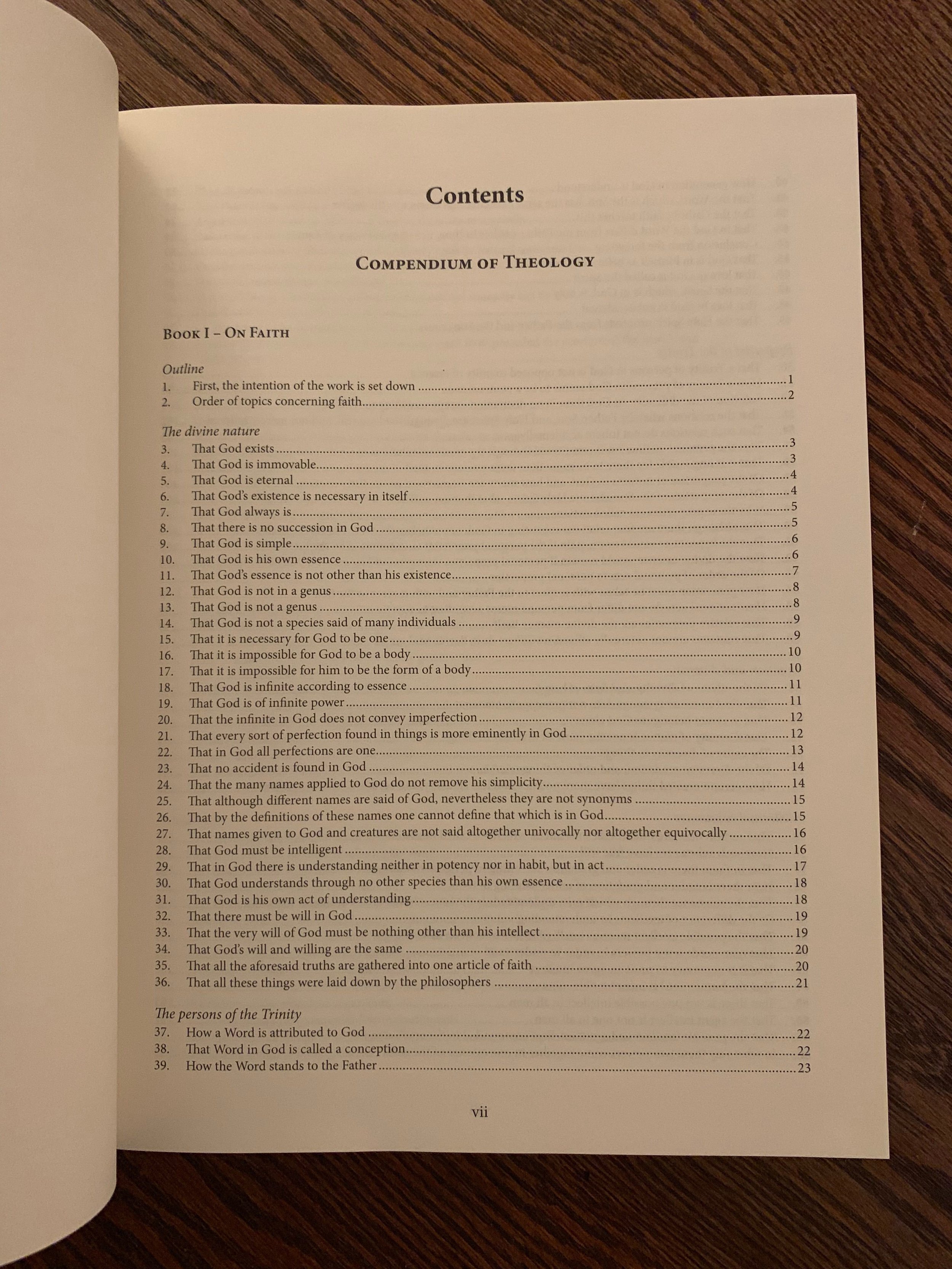
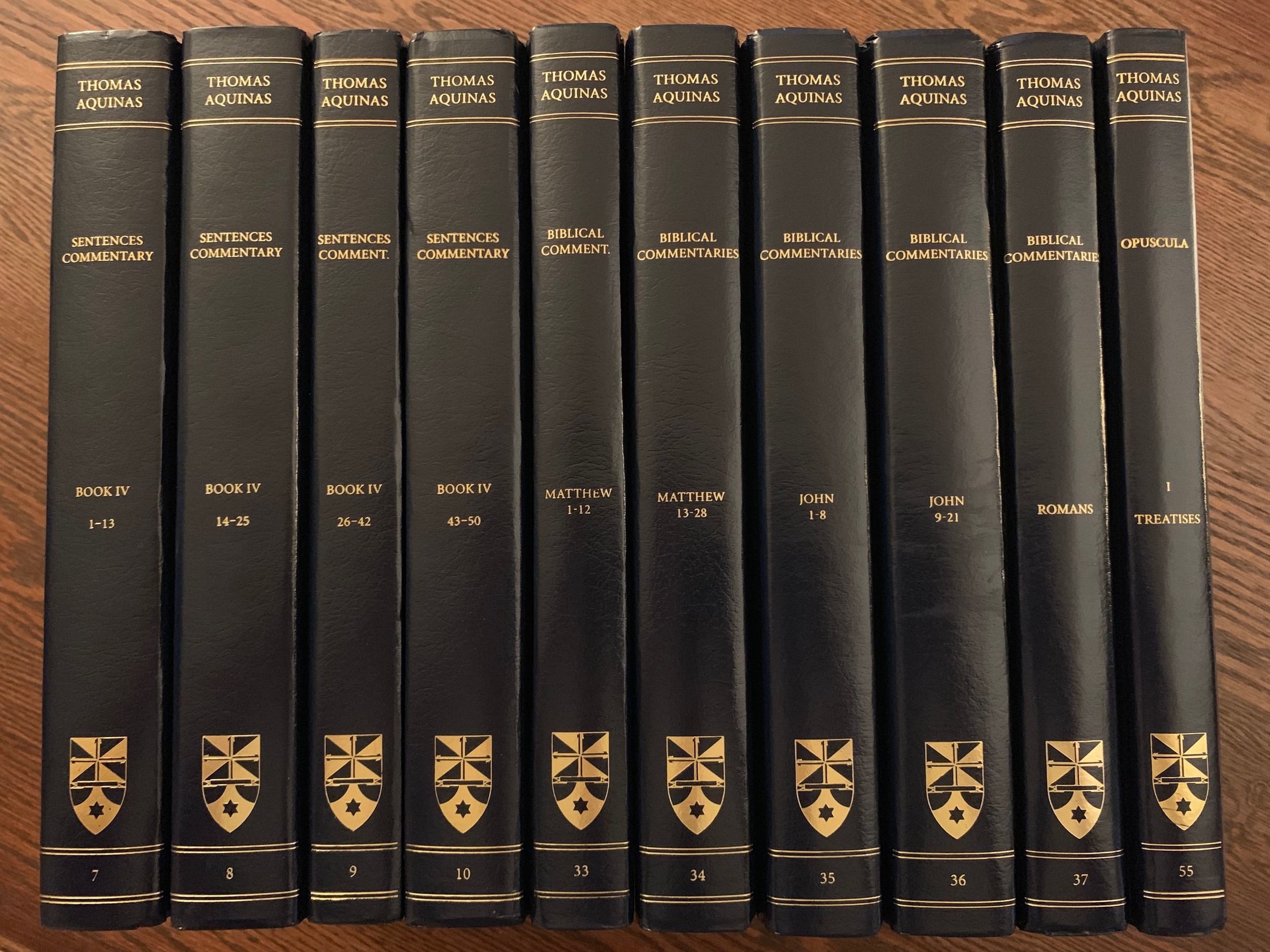
Almost exactly one year ago, the St. Paul Center for Biblical Theology and Emmaus Academic (under the direction of Dr. Scott Hahn) teamed up with the Aquinas Institute, the organization behind the famous opera omnia project led by Dr. John Mortensen. The Thomistic Institute has for several years been working diligently at producing a single complete set of the writings of St. Thomas Aquinas, with Leonine Latin and English translation side-by-side throughout. This particular author recently received a free sample copy of volume number 55—”Opusculum I”—as a gift from the St. Paul Center for review. Of the same series, I already have Aquinas’s biblical commentaries on St. Paul’s letter to the Romans and the gospels of Matthew and John, plus the entire fourth book of his commentary on the Sentences of Peter Lombard.

These volumes are a handful, sizing at about 11.5 inches tall by 8.5 inches wide. They are bound very well and encased within a beautiful blue imitation-leather hardback. The pages feel appropriately thick and almost elegant, with eye-friendly font and dimensions. Finally, there is sufficient marginal space for annotation, especially at the top and bottom of the pages. All in all, this series is splendidly beautiful and easily becomes the envy of any bookshelf, especially after one has compiled a number of volumes.

The most significant aspect of this series, however, is what is found printed on the paper. Not only does this Opera Omnia series provide stunning side-by-side Latin and English of Aquinas’s texts, although that alone would be worthy of attention. No, instead, the real contribution of this series is twofold. First, and most importantly, the Leonine critical Latin edition is made easily accessible to Thomistic scholars in a printed format that will (most likely) fit on office and home bookshelves practically anywhere. This is a major improvement from the opera omnia series that are generally only found as oversized volumes in the reference sections of theological libraries, if they even have them. Second, and quite interestingly, the entirety of Aquinas’s works will be made available in English for the first time ever. It is true that the Aquinas Institute has been relying on several previous English translations to populate their series; however, there are still many works that previously have never been translated beyond a few snippets here and there. Most especially, I am thinking of Aquinas’s massive Commentary on Lombard’s Sentences, but even several of his biblical commentaries, his correspondences, and his lesser known treatises. Because of the availability of the Leonine texts and because of the wave of new English translations, this series marks a major milestone in Thomistic scholarship.

As one can see from the St. Paul Center website, there are only select series available for purchase. A fuller picture of the publication process for individual volumes still in the works can be found on the Aquinas Institute website. Additionally, they have made available many of the texts online at Aquinas.cc. Even though there are still several volumes yet to be published, once the entire series is complete, it will be well worth the wait. In the meantime, there is plenty to enjoy and to use until then!

- Reviewed by Brandon L. Wanless

Merry Christmas!

The introit for yesterday’s vetus ordo Mass (Dominica infra Octavam Nativitatis) is quite beautiful:

Dum medium silentium tenerent omnia, et nox in suo cursu medium iter haberet, omnipotens sermo tuus, Domine, de caelis a regalibus sedibus venit. Dominus regnavit, decorum indutus est: indutus est Dominius fortitudinem, et praecinxit se.

The words are taken from Wisdom 18:14-15 and Psalm 92:1.

A comedy in four acts (updated)

After Jean-Luc Marion’s critique of Aquinas as an ontotheologian in L’idole et la distance (1977) and Dieu sans l'être (1982) people made a big deal of an alleged retraction in “Saint Thomas d’Aquin et l'onto-théo-logie” (1995) published in Revue thomiste. The text was even inserted into the 2013 edition of Dieu sans l'être as a supplement. In Marion’s “defense” of Aquinas against the charge of ontotheology in the Revue thomiste article he tells us that we should seriously consider the possibility that the esse that Aquinas predicates of God has no positive content but is purely a nom négatif. Indeed,

pourquoi pretendre le traiter comme un nom affirmatif, fournissant l’équivalent d’une essence, l’équivalent d’une concept, l’équivalent d’une définition, l’équivalent d’une connaissance?

Is this Marion channeling Sertillanges? Is he in earnest or is it all in jest?

I think it was the latter. Marion published an article in a 2004 issue of Conférence in which he argued once again, as he had before 1995, that Aquinas limits God’s transcendence by predicating esse of him.

Marion’s argument in the 2004 piece is weak, to say the least. He begins, harmlessly enough, by explaining that, for Aquinas, God’s esse and essentia aren’t really distinct from each other, as they are in creatures, but identical. This means that God isn’t simply an ens. However, he goes on, this won’t do to ensure God’s transcendence.

Que la transcendance de Dieu ne joue plus à l'intérieur d'un concept d'étant […] ne suffit pas à la libérer; puisqu'elle ne s'ouvre encore que dans l'interstice entre l'essence et l’esse, donc definitivement dans l'horizon de l’être.

It’s unclear whether être here is meant to refer to Heideggerian Sein (which Marion had mentioned in the previous paragraph). If it is, then Sein, being finite (as it surely seems to be), would necessarily limit God’s transcendence were he subject to it. But why should we think that esse and essentia as Aquinas predicates them of God can be reduced to Sein? If this is what Marion has in mind, he doesn’t explain why we should buy it. On the other hand, if être isn't Sein but has a more indefinite reference, why should we think it limits God? Marion doesn’t explain. Of course, we know that Aquinas holds that divine esse is unlimited (cf., e.g., ST, Ia, q. 13, a. 11). If God is without limits, then he can’t help but be transcendent. How does Marion show that Aquinas is wrong to think that divine esse is unlimited? He doesn’t.

The title of the 2004 article is “L’impossible pour l’homme – Dieu.” Marion presented an English version of it at one of John Caputo’s “Religion and Postmodernism” conferences at Villanova. But I don’t remember whether that was before or after the French version appeared.

Several years ago I thought about publishing something about all of this but I never got around to it. Maybe it doesn’t require any drawn-out discussion. The basics can be noted without much ado. In any event, let this blog post suffice for now.

(This is a reblog of a post of mine at the AMU Philosophy Department blog.)

***

Post scriptum (12.7.18): I should make it clear that I do think that, for Aquinas, esse as predicated of God does have some positive content. It’s not merely a negative name, as Marion suggests in the Revue Thomiste article. In the general debate about Aquinas’s apophaticism, I side with Maritain (and Garrigou, Cajetan, and — with some qualifications — Milbank) against Sertillanges.

Thomas Aquinas and Canon Law. T.A.C.L.

Justin M. Anderson (Seton Hall University), Mark Johnson (Marquette University), Atria Larson (St. Louis University) and myself are at the initial stages of setting up a “Thomas Aquinas and Canon Law. International Working Group” [T.A.C.L.]. The aim of T.A.C.L. is to bring together scholars of Thomas and of (medieval) canon law in order to trace and study the connections between these two fields.

In particular, medieval ecclesiastical law as a fount of Thomas’ own thought remains an important source which thus far has seem to be neglected.  Yet, that body of law holds significant importance in Aquinas’s moral, sacramental thought, etc. Below one can read a first description of our project as it can also be found on our website https://thomasaquinasandcanonlaw.wordpress.com/

Scholars who are interested in exploring these connections or can provide us with suggestions and comments on how to move forward are invited to contact us!

“Thomas Aquinas and Canon Law. International Working Group” [T.A.C.L.].

For nearly a century now, scholars involved in the study of Thomas Aquinas’s writings have sought to unearth the historical dimensions of his thought. This has included both studying the development of his arguments, but also his sources. As the decades have progressed, we have learned much of his indebtedness to his own contemporaries, but also to Scripture, to Augustine, to the neo-Platonic authors, and most recently to his Jewish and Muslim sources. However, one historical source that is largely, if not all together omitted, is Aquinas’s understanding and employment of the medieval canon law tradition, in particular both that of Gratian and the papal decretals.

Recent findings, especially regarding his use of the decretal tradition on vows, scandal, and truth have revealed that in all likelihood, Aquinas – like others around him – was both aware of and sought to include the logic of certain papal decrees within his own writings. When Pope Gregory IX wished to compile all the previous compilations into a single work, he asked none other than Raymond of Peñafort, Thomas Aquinas’s Dominican confrère who would – it is said – one day encourage Aquinas to write the Summa Contra Gentiles. Peñafort’s work was published in 1234 and is known as the Liber Extra. While the 12th Century’s Decretum Gratiani easily serves as an early benchmark in the medieval canon law tradition, the Liber Extra likewise serves as a similar point of reference established just under twenty years before Aquinas would begin to write. Moreover, according to the explorations of authors like Leonard Boyle and Joseph Goering, one cannot ignore that both canon lawyers and theologians, especially those in the Dominican houses of the 13th Century, were deliberately concerned with bringing their thought to bear in a practical way in the form of medieval penitentials. Here again Peñafort looms large. The medieval manuals for confessors became a meeting place and, consequently, a conduit of mutual influence between theology and canon law. Of course, the penitentials need not be the only locus of mutual influence. The Leonine edition of Aquinas’s Super Decretalem notes Henry of Segusio (a.k.a. Hostiensis), the author of multiple commentaries on medieval canon law itself, as one of Thomas’s potential sources.[1]

All of this points to a rich new field yet to be discovered. Still, in this nascent field questions abound. What or who were Aquinas’s influences regarding medieval canon law? With regard to what discussions, philosophical or theological, can we find Aquinas employing the decretal tradition? What, if any, secondary literature already exists in this regard? While our project is, at this stage, primarily focused on the influence the medieval decretal tradition had on Aquinas’s thought and writings, not to be ignored are the writings of other 13th Century philosopher-theologians who may also demonstrate the use of medieval canon law in their own thought, or by their writings have influenced Aquinas as a conduit. Furthermore, the causal direction may interestingly be turned around: what influence may Aquinas’s writings have had on later medieval canon law, decretists and/or decretalists?[2] Certainly the role of John of Fribourg could prove instrumental here as well.

Both Thomas’s œuvre and the medieval canon law tradition represent massive sources of knowledge in their own right. Tracing connections will likely require a familiarity with both. While the demand of such a study can make the task appear overwhelming, it is precisely because both fields of learning are so important that the work will prove both fruitful and intriguing.

[1] Sancti Thomae de Aquino, Opera omnia iussu Leonis XIII P. M., Tome 40, Pars D-E (Romae, 1968): E, p. 6.

[2] Historians of canon law often make a distinction between “decretists”, who commented on Decretum Gratiani, and “decretalists”, who commented on papal decretals including the Liber Extra.
1 Comment

Jörgen Vijgen

DR. JÖRGEN VIJGEN holds academic appointments in Medieval and Thomistic Philosophy at several institutions in the Netherlands. His dissertation, “The status of Eucharistic accidents ‘sine subiecto’: An Historical Trajectory up to Thomas Aquinas and selected reactions,” was written under the direction of Fr. Walter Senner, O.P. at the Pontifical University of St. Thomas Aquinas (Angelicum) in Rome, Italy and published in 2013 by Akademie Verlag (now De Gruyter) in Berlin, Germany.