Ethics, Politics, and Natural Law: Principles for Human Flourishing

Reviewed by Dr. Arielle Harms, Augustine Institute

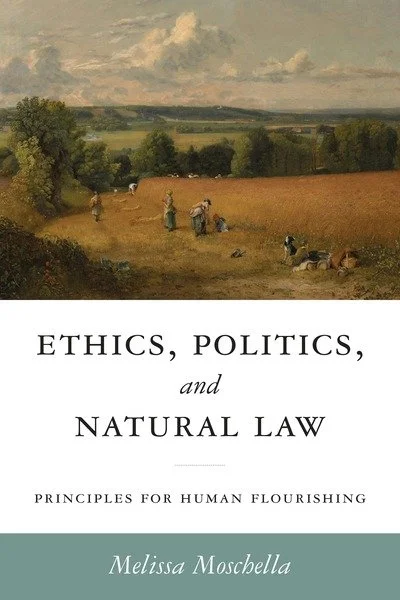
Melissa Moschella, Ethics, Politics, and Natural Law: Principles for Human Flourishing. University of Notre Dame, 2025. 232 pages. ISBN 9780268209261.

In contemporary treatments, natural law is certainly a misunderstood aspect of moral theology and ethics, and in Ethics, Politics, and Natural Law: Principles for Human Flourishing, Melissa Moschella sets out to explain natural law, offering to a smart audience what she proposes as a common sense approach to moral reasoning.  She presents the framework and details of the New Natural Law theory (NNLT) in a way that is approachable, systematic, and thorough. Her presentation seeks to connect “goods, norms, and virtues” which she says are isolated in contemporary moral theories.

I will admit that it was Dr. Moschella’s  desire for this exposition of NNLT to bridge the gap between New Natural Law theorists and “traditional Thomists” that led me to pick up this book.  In her introduction she states, “I see one of the purposes of this book as articulating NNLT in a way that can help to clarify some of the misconceptions that I believe underlie many if not most of the criticisms raised by those who consider themselves traditional Thomists.” (pp. 5-6) While Dr. Moschella does an excellent job explaining NNLT to a new audience,  contributing some very helpful additions to the way NNLT has been presented by other authors, the place of virtue in this presentation is minimal, and this Thomist is not convinced. 

Predictably, Chapter 1 delineates the incommensurable basic human goods as the first principles of practical reason responding to objections about what is not included in this list. 

Chapter 2, considers the principles that guide moral reasoning. Here, her presentation of the “vocation principle” is a novel way to help moral agents determine how best to order human goods, by prioritizing commitments that have already been made. 

Chapters 3-4 turn to applying the NNLT to life in society, looking at various levels of community from the family to the political community, and those that fall in between.  In Chapter 3 Dr. Moschella uses the hypothetical “Life of Susie” to show her reader the communities Susie will be involved in throughout her life and how these assist her in pursuing the basic human goods—as well as how she interacts with others in their pursuits.

Though NNLT is usually meant to ground moral reasoning without adverting to God, in Chapter 5, Moschella presents how belief in God, whether known through natural reason or through revelation, has relevance for NNLT, and in particular moral motivation. 

Though it would be impossible to address all the difficulties for a Thomist when it comes to Moschella’s presentation, I think it helpful to address one that may not get as much attention.  On the claim that this work in particular and NNLT in general helps to connect norms, goods, and virtues, in a way that supplements Aquinas’ account, the book unsurprisingly fails to deliver.  In discussing the knowability of the basic human goods, Dr. Moschella is careful to say that “natural law does not derive moral norms from speculative knowledge of human nature.” (pp. 40-41) She wants to keep a clear distinction between “first order knowledge” like metaphysics and “third order knowledge” like ethics.

However, for Aquinas, good is a metaphysical category, that is meaningless without reference to the nature referenced. Norms for human action are necessarily derived with reference to human nature and the good of human nature. In the relation of virtue to these terms, Moschella acknowledges that the use of “virtue” to sometimes refer to one of the basic human goods is not helpful and even confusing. (p. 21) Yet, because the norms for human action have already been detached from goodness in human nature, virtue must be described as the embodiment of moral principles (see pages 73-85), rather than the perfection of human action according to the good of human nature. While it is understandable that this short presentation of virtue is incomplete, what is missing is glaring: without the connection to goodness as a metaphysical reality, there is no clear way to account for the purpose of virtue, or to determine what the virtues are. Virtue, as presented here, bears little resemblance to Aquinas’ account—or that of Aristotle, to whom Moschella makes specific reference. For this reason, among others, I think she will fail to convince most “traditional Thomists.”

Even though she fails to accomplish the purpose of convincing the Thomists, Dr. Moschella’s presentation is extremely clear, and very readable. She systematically introduces and explains each part of NNLT, taking up some common-sense objections in the main text, and addresses the more scholarly objections in the footnotes. This book would make an excellent text for introducing students to NNLT. The annotated resource bibliography included at the end is also helpful for students or researchers who have not done much of reading in the NNLT school of thought, and includes general resources on NNLT, as well as works that approach specific questions of morality using a NNL framework.

Measured Mercy and Ordered Providence: A Thomistic Reading of Wisdom 11:21-12:2 in Light of Divine Governance

Measured Mercy and Ordered Providence: A Thomistic Reading of Wisdom 11:21-12:2 in Light of Divine Governance

The Book of Wisdom presents God’s governance as measured, merciful, and mediated through creation. This essay argues that Wisdom 11:21-12:2 exemplifies Aquinas’ providential framework by depicting moderated, creation-mediated punishments that mirror his distinction between providence and governance.

Read More

Return to the Heart: The Biblical Spirituality of St. Augustine's Confessions

Return to the Heart: The Biblical Spirituality of St. Augustine's Confessions

Return to the Heart is not necessarily meant to be a deeply academic work or scholarly commentary. Rather, as Owens himself states, it should serve as a “meditative and thematic mining of the spiritual classic” (xiv). In this approach, Dr. Owens succeeds. Indeed, the more that I read the more I was drawn into meditating on my own journey with the Lord.

Read More

Beauty and Imitation: A Philosophical Reflection on the Arts

Beauty and Imitation: A Philosophical Reflection on the Arts

In a post-modern, information-flooded world where we are amusing ourselves to death and in which self-conscious irony is entertainment king (because we are afraid to be sincere), it is more important now than ever to articulate accessibly and compellingly the purpose of the arts (and entertainment more broadly). They are meant as a gift to suggest to and orient man towards something definitively true: that he is made for a transcendental end. McInerny has certainly done so in this book, and for this we owe him a round of applause.

Read More

On Eternal Hell, against the murmurers

On Eternal Hell, against the murmurers

The debate between Universalists and Perditionists ultimately hinges on conflicting understandings of God’s will, justice, and the purpose of creation. Given the lack of Universalists’ ability to demonstrate the impossibility of hell, the only solution—as in the situation of the eternality of the world—is to look at the tradition and humbly ponder it.

Read More

Have I Alone Escaped to Tell You? Another Response to Knasas

Have I Alone Escaped to Tell You? Another Response to Knasas

Professor Knasas has kindly responded to my rejoinder to his reply to my review of his book. He considers, once again, Aristotle’s argument for the eternity of motion from time, discusses the limits of natural philosophic speculation when it comes to imagining realities beyond those limits, discusses the limits of the considerations of natural philosophy in regard to the human soul as a subject of contemplation, and concludes with a reminder to a text central to his aforementioned book (ST, Ia, q. 44, a. 2) as emblematic of his interpretation as part of the project of existentialist Thomism.

Read More

Has Brungardt Escaped the Eternity of the World?: Further Thoughts

 Has Brungardt Escaped the Eternity of the World?: Further Thoughts

In a previous Thomistica posting I contended that Aquinas reformulates Aristotle’s third argument for the eternity of motion. The third argument is the argument from the eternity of time. In this third argument the now of time is characterized as middle such that there is always a now before and a now after. The argument includes the unfortunate comparison of the now of time to the point of a line. The comparison invites the easy rebuttal that the end points of a line are not middles and so perhaps not all nows are middles. The third argument can, then, proceed only by begging the question about all nows being middles.

Read More

Thomas Aquinas: Selected Commentaries on the Old Testament

Thomas Aquinas: Selected Commentaries on the Old Testament

These commentaries are a rich addition to the continued study of St. Thomas Aquinas and his thought, especially as it relates to Sacred Scripture. This is certainly a worthwhile addition to any library and the necessary completion to the set. Once again, Jason Paone and Word on Fire Academic has produced an eminently usable and needed volume of the Scriptural work of the Angelic Doctor.

Read More

Natural Philosophy Does Not Lead to Heresy: A Reply to John F. X. Knasas

Natural Philosophy Does Not Lead to Heresy: A Reply to John F. X. Knasas

In this essay, I respond to various points and counterarguments made by John F. X. Knasas in his reply to my review of his book. (In what follows, all quotations unless sourced otherwise are from Knasas’s reply.) Knasas’s main focus is my contention that it is not necessary to deploy metaphysics to defeat the Aristotelian arguments for the eternity of motion and time. In particular, he disputes the end of §4 of my review, beginning with “Absent from this analysis, however, ...”.

Read More

Thomistic Mystagogy: St. Thomas Aquinas's Commentaries on the Mass

Thomistic Mystagogy: St. Thomas Aquinas's Commentaries on the Mass

It makes for a difficult task to review a book that contains no material ambiguities, let alone any asserted errors whatsoever; that is, I agree with everything I read. Hannon clearly has contemplated carefully, deeply, and regularly how Aquinas considers the intricate words and actions of the Mass; undoubtedly, he has done the same for the liturgy itself. 

Read More

Astrobiology and Christian Doctrine

Astrobiology and Christian Doctrine

[Davison's] inquiry proceeds at two mutually reinforcing levels: a natural theology of creation that informs arguments about the fittingness and possibility of rational life beyond the human domain as well as a strictly theological speculation about the implications of such a possibility for our understanding of the Trinity, the Incarnation and the person of Christ, and eschatology.
Read More

Recovering Aquinas’s Motion Proof

Recovering Aquinas’s Motion Proof

For too long has Aquinas’s motion proof languished in the gaol of a contemporary Thomistic metaphysics unwilling to fully countenance the debt which Aquinas’s metaphysics owes to Aristotelian natural philosophy and unable to recapture the ground taken by materialist, naturalist, or positivist accounts of the cosmos. Shields’s book represents a real jail-break and counterattack.

Read More