A comedy in four acts (updated)

After Jean-Luc Marion’s critique of Aquinas as an ontotheologian in L’idole et la distance (1977) and Dieu sans l'être (1982) people made a big deal of an alleged retraction in “Saint Thomas d’Aquin et l'onto-théo-logie” (1995) published in Revue thomiste. The text was even inserted into the 2013 edition of Dieu sans l'être as a supplement. In Marion’s “defense” of Aquinas against the charge of ontotheology in the Revue thomiste article he tells us that we should seriously consider the possibility that the esse that Aquinas predicates of God has no positive content but is purely a nom négatif. Indeed,

pourquoi pretendre le traiter comme un nom affirmatif, fournissant l’équivalent d’une essence, l’équivalent d’une concept, l’équivalent d’une définition, l’équivalent d’une connaissance?

Is this Marion channeling Sertillanges? Is he in earnest or is it all in jest?

I think it was the latter. Marion published an article in a 2004 issue of Conférence in which he argued once again, as he had before 1995, that Aquinas limits God’s transcendence by predicating esse of him.

Marion’s argument in the 2004 piece is weak, to say the least. He begins, harmlessly enough, by explaining that, for Aquinas, God’s esse and essentia aren’t really distinct from each other, as they are in creatures, but identical. This means that God isn’t simply an ens. However, he goes on, this won’t do to ensure God’s transcendence.

Que la transcendance de Dieu ne joue plus à l'intérieur d'un concept d'étant […] ne suffit pas à la libérer; puisqu'elle ne s'ouvre encore que dans l'interstice entre l'essence et l’esse, donc definitivement dans l'horizon de l’être.

It’s unclear whether être here is meant to refer to Heideggerian Sein (which Marion had mentioned in the previous paragraph). If it is, then Sein, being finite (as it surely seems to be), would necessarily limit God’s transcendence were he subject to it. But why should we think that esse and essentia as Aquinas predicates them of God can be reduced to Sein? If this is what Marion has in mind, he doesn’t explain why we should buy it. On the other hand, if être isn't Sein but has a more indefinite reference, why should we think it limits God? Marion doesn’t explain. Of course, we know that Aquinas holds that divine esse is unlimited (cf., e.g., ST, Ia, q. 13, a. 11). If God is without limits, then he can’t help but be transcendent. How does Marion show that Aquinas is wrong to think that divine esse is unlimited? He doesn’t.

The title of the 2004 article is “L’impossible pour l’homme – Dieu.” Marion presented an English version of it at one of John Caputo’s “Religion and Postmodernism” conferences at Villanova. But I don’t remember whether that was before or after the French version appeared.

Several years ago I thought about publishing something about all of this but I never got around to it. Maybe it doesn’t require any drawn-out discussion. The basics can be noted without much ado. In any event, let this blog post suffice for now.

(This is a reblog of a post of mine at the AMU Philosophy Department blog.)

***

Post scriptum (12.7.18): I should make it clear that I do think that, for Aquinas, esse as predicated of God does have some positive content. It’s not merely a negative name, as Marion suggests in the Revue Thomiste article. In the general debate about Aquinas’s apophaticism, I side with Maritain (and Garrigou, Cajetan, and — with some qualifications — Milbank) against Sertillanges.

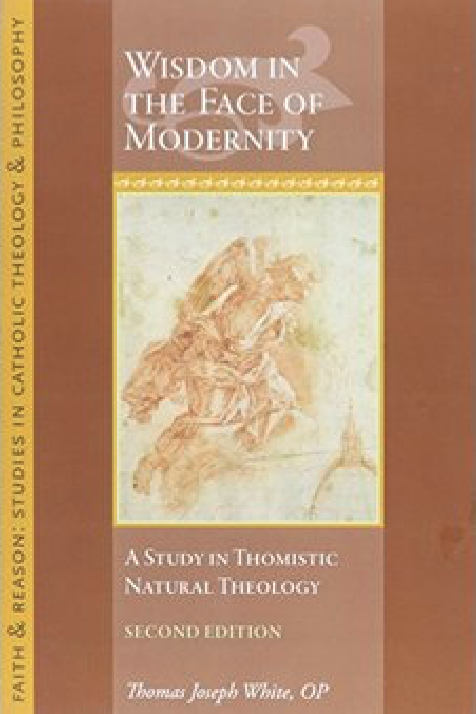
Wisdom in the Face of Modernity: Second Edition

Sapientia Press has released the second edition of Wisdom in the Face of Modernity, A Study in Thomistic Natural Theology.

In this remarkable presentation of Aquinas’ natural theology, Fr. Thomas Joseph White attempts to not only clearly present the Angelic Doctor’s teaching, but to also respond to challenges brought forward by modern authors.

 In response to the criticisms of ontotheology by Kant and Heidegger and their claims that the philosophical arguments presented by scholastics such as Aquinas are no longer tenable, White argues that they gravely misunderstood the philosophical presuppositions of classical natural theology. St. Thomas, White insists, would not have appealed to an aprioristic kind of intuition of God as Kant and Heidegger seem to presuppose he would have.

One of the major goals of the book is to explain the order of metaphysical discovery in terms of what Aquinas refers to as a via intentionis (according to which man begins with his experiential knowledge of that which exists and then goes on to analyze the metaphysical structure of concrete beings by means of a posteriori arguments). In this context, he examines the claims of Gilson, Maritain and Rahner regarding the order of discovery and maintains that a renewed appreciation of St. Thomas’ Aristotelianism could help us correct some of the defects in their otherwise meritorious contributions.

Finally, the book also investigates the ways that the study of natural theology can affect the study of theology. Interestingly, White considers the apophatic and cataphatic aspects of Aquinas from a philosophical point of view while pointing out that even if we can know something about what God is by means of analogy, the human mind naturally has some conception of its inadequacy and thus even on the natural level has some kind of velleity for a more perfect knowledge of God.

This edition has three new appendices :

-       Philosophical Wisdom and the Final End of Man: Thomas Aquinas and the Paradigm of Nature-Grace Orthodoxy

-       Divine Names

-       On the Nature of Christian Philosophy: A Response to Critics

 - Reviewed by Ryan J. Brady

Comment

Ryan J Brady

Dr. Brady is an associate professor of Theology at St. John Vianney College Seminary and Graduate school. He has taught courses in theology, classics and early Christian studies at St. Vincent de Paul Regional Seminary and Ave Maria University. Subsequent to a few semesters of study at Thomas Aquinas College, he graduated from La Salle University in Philadelphia with a B.A. in Religion. After receiving a Masters degree in Systematic Theology from Christendom Graduate School (where he was the valedictorian) he defended his doctoral dissertation “Aquinas on the Respective Roles of Prudence and Synderesis vis-à-vis the Ends of the Moral Virtues” with distinction and received his Ph.D. in Systematic Theology. His forthcoming book with Emmaus Academic is entitled, “Conforming to Right Reason.”