Calling All Teachers: Submit a Pedagogical Essay to Thomistica!

Do you ever teach material involving St. Thomas Aquinas? Do you have an insightful way of presenting St. Thomas on virtue? the soul? the First Way? Is there an “Introduction to Aquinas” class that you have found actually works?

As we near the end of another semester, looking back, have you finally found a way to convince your students of time-honored Thomistic wisdom?

Thomistica invites you to send an essay on your pedagogical approach to teaching the Angelic Doctor on any subject. Your fellow Thomistic teachers look forward to the benefit and discussion.

See the submissions page to send something our way.

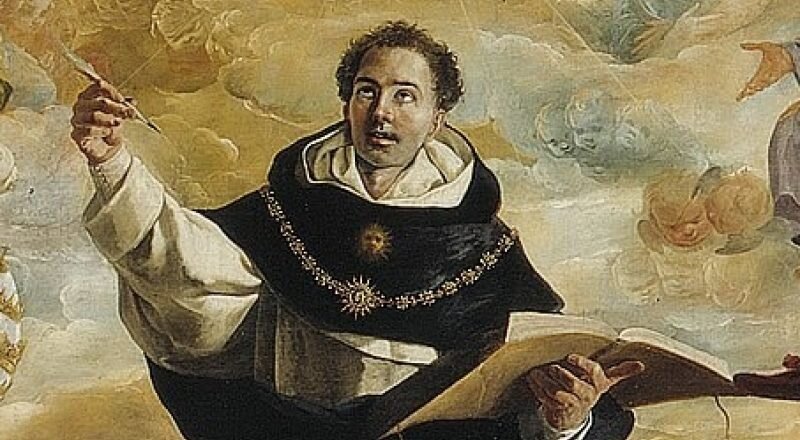
THE TRIUMPH OF ST. THOMAS (BENOZZO GOZZOLI)

Reading and Discussing the Summa Contra Gentiles in Latin

For anyone who is interested in improving his or her spoken Latin while reading Thomas, the Veterum Sapientia Institute is offering a great opportunity to do so while going through the text of the Summa Contra Gentiles.

stthomas2-800x440.jpg

The course, “Reading and Discussing the Summa Contra Gentiles in Latin,” will take place on Fridays at 8:00 a.m. from April 16-June 18, and will be taught by Daniel Gallagher (Cornell University). Each class will consist of reading, summarizing, and discussing select passages from Book I of the SCG in Latin, as well as exercising grammar through oral drills. Although no prior experience in spoken Latin is necessary, participants should have a solid grasp of Latin grammar. They should also be relatively comfortable reading Aquinas in the original Latin and be willing to speak Latin during class. Most of the course will be conducted in Latin with segments in English as necessary. More information: https://veterumsapientia.org/courses/tsl225-reading-and-discussing-the-summa-contra-gentiles-in-latin/

Comment

Ryan J Brady

Dr. Brady is an associate professor of Theology at St. John Vianney College Seminary and Graduate school. He has taught courses in theology, classics and early Christian studies at St. Vincent de Paul Regional Seminary and Ave Maria University. Subsequent to a few semesters of study at Thomas Aquinas College, he graduated from La Salle University in Philadelphia with a B.A. in Religion. After receiving a Masters degree in Systematic Theology from Christendom Graduate School (where he was the valedictorian) he defended his doctoral dissertation “Aquinas on the Respective Roles of Prudence and Synderesis vis-à-vis the Ends of the Moral Virtues” with distinction and received his Ph.D. in Systematic Theology. His forthcoming book with Emmaus Academic is entitled, “Conforming to Right Reason.”

Buona festa di s. Tommaso!

March 7 is St. Thomas's liturgical feast according to the pre-1969 General Roman Calendars. St. Thomas died on that date in 1274 at the abbey of Fossanova, where he had stopped after taking ill on his way with Reginald da Piperno to the second Council of Lyons.

January 28 is St. Thomas’s liturgical feast according to the General Roman Calendar of 1969. On that date in 1369 St. Thomas’s relics were translated to the Dominican church in Toulouse.

Happy feast of St. Thomas!

January 28 is the feast of St. Thomas Aquinas in the 1969 General Roman Calendar. Happy feast day!

This would be the perfect day to listen to Ēriks Ešenvalds truly heavenly setting of St. Thomas’s eucharistic hymn O salutaris hostia. Here’s a performance of it by the choir of Trinity College Cambridge conducted by Stephen Layton.

Whose cogito?

When Descartes’s friend Marin Marsenne read the Discourse on Method he pointed out the similarity between Descartes’s cogito argument and an argument of St. Augustine’s in the City of God, XI, 26. Against the suggestion that he might be mistaken about his own existence, Augustine writes:

Quid si falleris? Si enim fallor, sum. Nam qui non est, utique nec falli potest; ac per hoc sum, si fallor. Quia ergo sum si fallor, quomodo esse me fallor, quando certum est me esse, si fallor? Quia igitur essem qui fallerer, etiamsi fallerer, procul dubio in eo, quod me novi esse, non fallor. Consequens est autem, ut etiam in eo, quod me novi nosse, non fallar.

It has now become standard to note the similarity between Descartes’s argument and Augustine’s.

But no one seems ever to note the similarity between the cogito argument and certain arguments proposed by St. Thomas. Consider De veritate, q. 10, a. 12, for example. In this article Thomas asks whether God’s existence is per se notum. In the seventh objection we read this:

…verius esse habet Deus quam anima humana. Sed anima non potest se cogitare non esse. Ergo multo minus potest cogitare Deum non esse.

Thomas replies in the following way:

[C]ogitari aliquid non esse, potest intelligi dupliciter. Uno modo ut haec duo simul in apprehensione cadant; et sic nihil prohibet quod aliquis cogitet se non esse, sicut cogitat se quandoque non fuisse. Sic autem non potest simul in apprehensione cadere aliquid esse totum et minus parte, quia unum eorum excludit alterum. Alio modo ita quod huic apprehensioni assensus adhibeatur; et sic nullus potest cogitare se non esse cum assensu: in hoc enim quod cogitat aliquid, percipit se esse.

So, no one can assent to the thought that he does not exist because in the very act of thinking he perceives that he exists. (The same pattern of argument can be found in De veritate, q. 10, a. 8, ad 5 and Summa contra gentiles, III, c. 46.) Unlike Descartes, however, Thomas does not make this truth into a first principle. For Thomas, being (ens) is the first principle because, he says, it is the first thing that is “most evident” (notissimum) to us (De veritate, q. 1, a. 1).

(I originally posted this on the AMU Philosophy Department blog last month. I believe in recycling. It’s good for our planet.)

Maximus on Divinization: Not the actualization of a natural passive potency

From Amiguum 20. “The grace of divinization is completely unconditioned, because it finds no faculty or capacity of any sort within nature that could receive it, for if it did, it would no longer be grace but the manifestation of a natural activity latent within the potentiality of nature. And thus, again, what takes place would no longer be marvelous if divizination occurred simply in accordance with the receptive capacity of nature. Indeed it would rightly be a work of nature, and not a gift of God, and a person so divinized would be God by nature and would have to be called so in the proper sense. For natural potential in each and every being is nothing other than the unalterable movement of nature toward complete actuality. how, then, divinization could make the divinized person go out of himself, I fail to see, if it was something that lay within the bounds of his nature.”

What a slave to Aristotle.

Safetyism

It has a name and a definition. We’ve been experiencing it for about a decade (or more?) but I never knew what to call it (at least I never hit on anything pithy) or how to define it. Check out NY Times opinion editor Bari Weiss’s informative explanation:

Screen Shot 2020-06-12 at 9.39.29 AM.png

What do Thomists think of safetyism? If you’re an American academic, safetyism isn’t something you can ignore. It has also become a major force in our politics; but that isn’t news to anyone. Are we now beyond liberalism or is this a creature of liberalism?

Religion and postmodernism

In February I gave a talk for the Thomistic Institute at Mississippi State University entitled “Is Postmodernism a Problem for Religion?” In the first half of the talk I pack in a discussion of truth, reason, fideism, constructivism, and skepticism. This is meant to set up what comes next. In the second half I discuss Jean-François Lyotard and Thomistic philosophical theology with the aim of showing that the latter is unscathed by Lyotard’s critique of metanarratives in The Postmodern Condition. Inspired by Wittgenstein, Lyotard argues (more or less) that truth is language game dependent (hence, l’incrédulité à l’égard des métarécits). I counter that this can’t be the case for all truths and that it is, in any event, self-refuting in an obvious way. The talk was pitched to a general audience, so I did my best to put things simply and non-technically. You can find an audio recording of it here.

Now Is Not the Time

In this post, Matthew Dugandžić, Assistant Professor of Moral Theology at Saint Mary’s Seminary and University, addresses the concerns many have about not being able to receive Communion. 

In view of the COVID-19 health crisis, Governor Larry Hogan of Maryland, where I live, issued a stay-at-home order yesterday. The Archdiocese of Baltimore responded by closing all parish churches, such that no more than ten individuals will be allowed to pray inside a church at any one time. As is happening throughout the United States, masses are no longer taking place publicly, but will be livestreamed so that the faithful can watch them from the safety of their homes. The sacraments – including reconciliation – are to be performed only when an individual is in danger of dying.

Many wonder if this is the correct course of action. It does seem unwise to suspend baptisms – which could easily be performed with a crowd of ten or fewer – but what of the cancellation of public masses? Of particular note, Rusty Reno at First Things, has argued that, even if the COVID-19 pandemic be serious, the bishops ought to keep their churches open for prayer. Open, that is, to more than ten people at once. People can make their own decisions about whether to go to mass or not, but the Church herself should be concerned with “the spiritual health of those entrusted to her care,” rather than “imitate the … worldliness of those who work for public health.”   First, we must “grow in our love for God, for only then will we have the firm foundation on which to endure the sacrifices and responsibilities that come with loving our brothers.” In short, spiritual concerns trump temporal ones.

No Christian would deny that loving God is our first priority, or that spiritual goods are higher than temporal goods. But the way Reno paints the picture, there is some conflict between loving God and loving neighbor. We must love God first, and then we can love our neighbor. Closing churches for the sake of people’s health is an inversion of priorities. But the Gospel tells us that whatever we do for the least of Jesus’s brothers, we do for God himself (Matt. 25:40). This includes providing for the temporal needs of our brethren, which can be an act of charity, and all acts of charity are done to show God love (ST, II-II, q. 27, a. 6). Caring about our neighbor is loving God – there is no conflict. Accordingly, there is a time for everything, as Qoheleth says, a time to show our love for God by going to church, and a time to show our love for God by staying home.

Understanding this boils down to a simple axiom that Aquinas often repeats: affirmative precepts are always binding, but they do not always bind. Take something tangible: We should honor our parents. But does that mean that we should be actively engaged in the act of honoring our parents at each and every moment of our lives? No. That would be impossible. Keeping the fourth commandment means never dishonoring our parents and honoring them when the situation calls for it. (De malo, q. 2, a. 1, ad 11). Even when it comes to something as important as confessing the faith, which we give great honor to the martyrs for doing at the expense of their lives, we are not bound to do this at all times, but only “in certain times and places” (ST, II-II, q. 3, a. 2, co.). Going to church on Sunday is an affirmative precept; it ought only be done at the right time.

Accordingly, although loving God is our top priority, we do so in different ways at different times. Some activities, like contemplation, are directly concerned with our love of God. Others, like eating a sandwich, are less so. Saint Paul does say, after all, that whether “you eat or drink, or whatever you do, do everything for the glory of God” (1 Cor. 10:31). As Aquinas explains, this means that we ought to refer these lesser acts to God habitually (De malo, q. 7, a. 1, ad 9). We eat our lunch as creatures who love God and wish to glorify him, but who also must strengthen ourselves by eating now so that we might glorify him in a better way later. Similarly, a cleric who is normally bound to say matins in the morning might instead say them in the evening if something important – like his duty to teach a class – prevents him from saying matins at the normal hour (Quodlibit q. 14, unic.). We, as temporal creatures, simply cannot be in a state of prayer at all times (ST, II-II, q. 83, a. 14, co.).

This is all to say something simple: life is full of goods – both spiritual and temporal – that we ought to pursue. And these goods are certainly hierarchical, with the good of loving God at the very top of the hierarchy. And yet we are not called to pursue every one of these goods explicitly at every time, but rather at the right time. And some situations call for us to pursue a lower good than the one that we might otherwise pursue. If a person were at Sunday mass and a fire broke out in a building across the street, should the person wait for mass to end before going to help people out of the burning building? Or should he leave mass and help the people in need before it is too late? Clearly, if a person who is merely sick with a contagious illness does not have to attend Sunday mass (and, indeed, ought not, since the person should take care of his health now so as to render due worship to God later, and should be mindful not to spread his disease to people who may be vulnerable to it), then certainly neither does the person who has an opportunity to help those in grave need right now.

And this is not so much different from the situation that we are in. Our neighbors are in grave need. They are in need of us not to go to mass. Many of us could be carrying the novel coronavirus without knowing it. We could easily pass it on to those who may suffer gravely from it. Simply telling everyone to make up their own minds about whether to go to mass would not suffice. Many people who should not go will end up going, some out of ignorance, some out of misplaced guilt at missing Sunday mass, some for other reasons. The most effective way to deal with the preset problem is to make it clear to people that they, in these circumstances, have no obligation to go to mass and indeed ought not. This is not a paternalistic imposition, but rather a service that those who have authority over us are providing for us.

This decision to close churches for public prayer need not be seen as spiritual abandonment. And it is not. The faithful still have means at their disposal to receive the grace of the Eucharist in spiritual Communion. There are dozens upon dozens of options available for Catholics to livestream different liturgical services. The sacraments can still be physically administered in cases of grave need. But more importantly, this is an opportunity to forego a great good for the sake of helping our neighbors, all in view of rendering glory to God. It so happens that in this circumstance, the way we should render God his glory is not by going to mass, but by depriving ourselves of this blessed opportunity for the sake of our brothers in Christ. Being deprived of the opportunity to worship in communion and to receive the Eucharist physically is an opportunity to reflect on just how great these gifts are, which should cause us to long for them even more than we normally do, and to find even more joy in them when we finally get to return to them, thus showing God even greater glory. Worshiping in communion is a great thing. Receiving the Eucharist physically is a great thing. Normally, we ought to do these things. But now is not the time.

1 Comment

Ryan J Brady

Dr. Brady is an associate professor of Theology at St. John Vianney College Seminary and Graduate school. He has taught courses in theology, classics and early Christian studies at St. Vincent de Paul Regional Seminary and Ave Maria University. Subsequent to a few semesters of study at Thomas Aquinas College, he graduated from La Salle University in Philadelphia with a B.A. in Religion. After receiving a Masters degree in Systematic Theology from Christendom Graduate School (where he was the valedictorian) he defended his doctoral dissertation “Aquinas on the Respective Roles of Prudence and Synderesis vis-à-vis the Ends of the Moral Virtues” with distinction and received his Ph.D. in Systematic Theology. His forthcoming book with Emmaus Academic is entitled, “Conforming to Right Reason.”

Antoine Touron’s 'La Vie de S. Thomas d’Aquin'

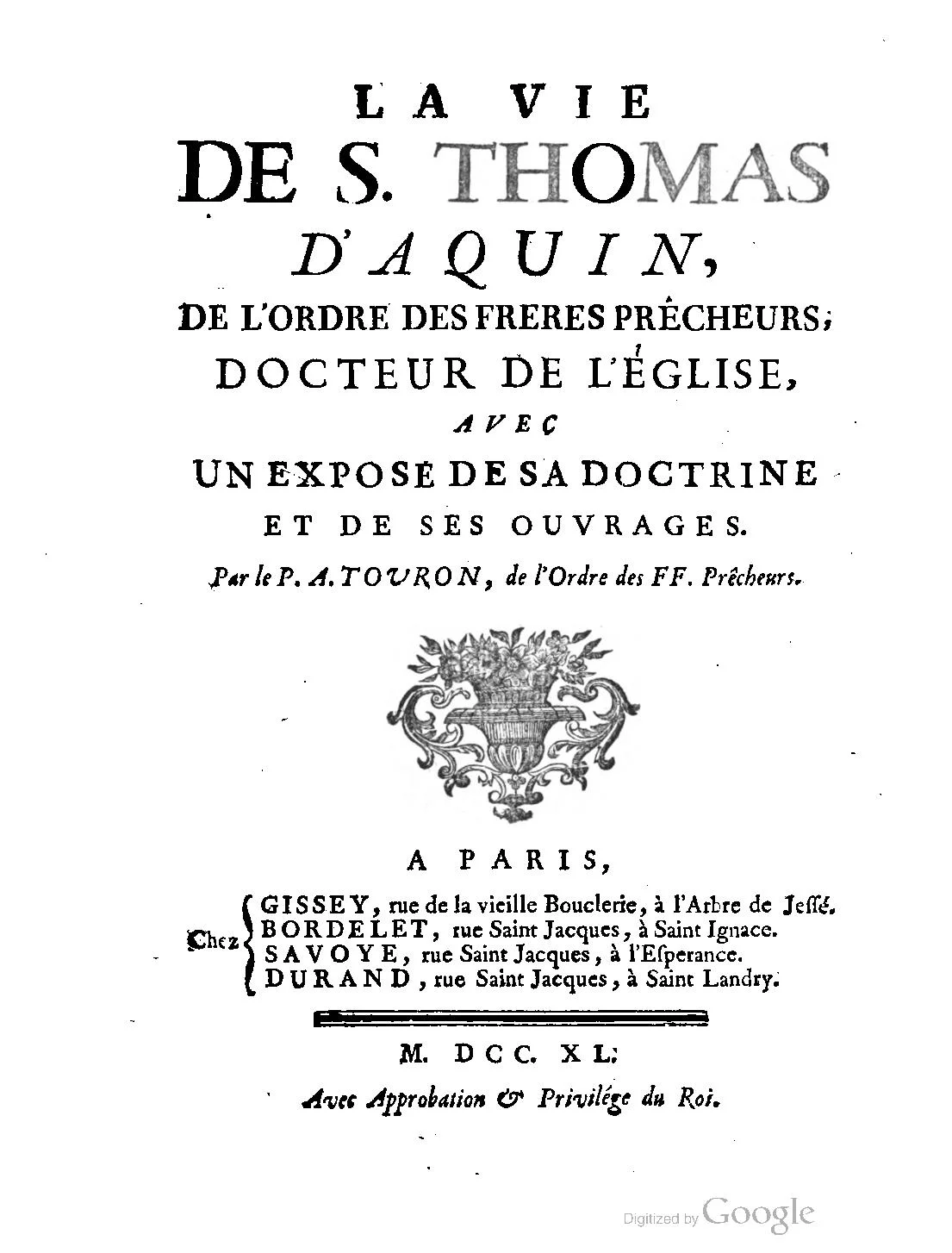
The attempt to provide an ‘objective’ and accurate description of the life of St. Thomas by contemporary biographers can sometimes lead to losing sight of the central motives of his thought and spirituality. In addition to these biographies, therefore, it is worthwhile to read La vie de S. Thomas d'Aquin de l'Ordre des Frères Prêcheurs, Docteur de l'Église, avec un exposé de sa doctrine et de ses ouvrages, first published in 1737 by Antoine Touron (1686-1775), the French Dominican biographer and historian.

While Books I-III (pp. 1-312) and V-VI (516-696) - which deal with his life, work and reception by the Church - can be easily found in modern biographies, it is Book IV (pp. 322-504), the center piece of the work, which intends to give us an insight into the heart of the saint and scholar. While a mere list of the chapters and subchapters of Book IV (see here) will be enough to inspire readers (and perhaps a translator), here follows just one beautiful observation of Antoine Touron O.P.

Touron devotes a chapter of Book IV to “the sources from which St. Thomas has drawn science and wisdom”. In describing the second source as “the knowledge and love for Jesus Christ and His Cross”  - the first source being “the intimate union with God through continual prayer” – he notes that “the Cross of his Savior was his first Book, the great object of his meditations, the rule of his entire life. It is at the foot of the Cross that he humiliated his mind in order to merit the understanding of the Mysteries. At the foot of the Cross he purified his heart in order to render it able to receive such understanding.” Touron continues by saying that “this divine wisdom, which the Apostle acquired in the third heaven, the beloved disciple on the breast of the Savior, St. Augustine in the Scriptures, St. Thomas learned at the feet of the Cross. The wounds of Jesus Christ were the masters whom he consulted in his doubts, and to whom he listened in his difficulties. […] It is from this source that he drew the principles of his science, the abundance and purity of his doctrine.”

Touron 1740 La_vie_de_saint_Thomas_d_Aquin-6-page-001.jpg
Comment

Jörgen Vijgen

DR. JÖRGEN VIJGEN holds academic appointments in Medieval and Thomistic Philosophy at several institutions in the Netherlands. His dissertation, “The status of Eucharistic accidents ‘sine subiecto’: An Historical Trajectory up to Thomas Aquinas and selected reactions,” was written under the direction of Fr. Walter Senner, O.P. at the Pontifical University of St. Thomas Aquinas (Angelicum) in Rome, Italy and published in 2013 by Akademie Verlag (now De Gruyter) in Berlin, Germany.

New Book on Lying and Homosexual Activity

John Skalko has published a book, Disordered Actions: A Moral Analysis of Lying and Homosexual Activity.

https://www.amazon.com/Disordered-Actions-Analysis-Homosexual-Activity/dp/3868382186/ref=sr_1_1?keywords=disordered+actions&qid=1563825462&s=books&sr=1-1

There is to the best of my knowledge no previous scholarly book-length defense of Aquinas on homosexuality.  Prior to the publication of Skalko’'s work, you only had Gareth Moore and Adriano Oliva, both Dominicans, who either attacked or reinterpreted Aquinas. I reviewed Oliva’s work for The Thomist, and it seemed to me either incompetent or dishonest.

"Apostle to the Apostles"

Titian, Noli me tangere, 16th century

Three years ago, Pope Francis elevated the July 22 liturgical memorial of St. Mary Magdalene to the dignity of a feast day to be celebrated universally throughout the Church on par with feasts of the apostles. He also gifted the great saint with the title of “Apostle to the Apostles,” an ancient designation first tokened in part by St. Thomas Aquinas himself. In his Lectura super Ioannis, we find this passage in caput 20, lectio 3:

“Note the three privileges given to Mary Magdalene. First, she had the privilege of being a prophet because she was worthy enough to see the angels, for a prophet is an intermediary between angels and the people. Second, she had the dignity or rank of an angel insofar as she looked upon Christ, on whom the angels desire to look. Third, she had the office of an apostle; indeed, she was an apostle to the apostles insofar as it was her task to announce our Lord’s resurrection to the disciples. Thus, just as it was a woman who was the first to announce the words of death, so it was a woman who would be the first to announce the words of life.” (2519)

Aquinas affords a triple dignity to Mary Magdalene, the first disciple to bear witness to the resurrected Jesus Christ: she is a prophetess, an angelic messenger, and an apostolic figure. As a witness to the resurrection and as a bearer of the glad tidings from the resurrected Christ, Mary is portrayed by St. John as an apostle commissioned by Jesus himself to the apostles. It should not surprise us that the Common Doctor picks up on this archetypal role filled by the Magdalene.

On this universal feast of the Church, let us give thanks to God for the evangelical witness of St. Mary Magdalene who “first announce[d] the words of life,” and for our indebtedness to St. Thomas Aquinas for naming her “apostle to the apostles.”

With thanks to Rev. John Ubel for the inspiration for this post.

Leonard E. Boyle O.P.

Boyle Leonard E. (1923-1999).jpg

On the 25th of October 2019, the Thomistic community will commemorate the 20th anniversary of the death of father Leonard  E. Boyle O.P. (1923-1999) who taught for many years at the Pontifical Institute of Mediaeval Studies (before becoming Prefect of the Vatican Library in 1984) and as such had a formative influence on an entire generation of Thomists. His most important publications on Thomas were collected in Facing History: A Different Thomas Aquinas (Louvain-la-Neuve: FIDEM, 2000). His enduring scientific legacy for the Thomistic community centers in my modest view around two novel contributions. First, the historical situatedness of Thomas’ moral thought, in particular within the Dominican educational context of the 13th century, a topic which he developed from a much wider perspective as well (see his collection Pastoral Care, Clerical Education and Canon Law, 1200-1400, London: Variorum Reprints, 1981 and in particular his “Notes on the Education of the Fratres Communes in the Dominican Order in the Thirteenth Century”). Understanding the mindset of Thomas’s most influential contribution, the Summa theologiae and in particular the novelty of the Secunda pars requires taking into account father Boyle’s work and its continuation by J.-P. Torrell, M. Michele Mulcahey and others. His second contribution concerns the notorious alia lectura fratris Thome, that is to say, a set of marginal annotations in the Oxford manuscript Lincoln College lat. 95. In his 1980 article, which reads like a thrilling detective’s quest, father Boyle turns father Hyacinth Dondaine’s arguments around and concludes in favor of the authenticity of these marginal notes. The notes in their entirety were finally published by John P. Boyle as Lectura romana in primam Sententiarum Petri Lombardi (Toronto: PIMS, 2006). The debate that followed this edition, both regarding the authenticity of the content of the notes as well as the attribution of the different hands, remains ongoing but in any case testifies to the ingenuity of father Boyle and the importance of returning to the manuscripts. (A brief survey of the discussion can be found in Torrell’s new edition of his Initation à saint Thomas d’Aquin. Sa personne et son oeuvre (Paris: Cerf, 2015, 73-77).

Father Boyle, who both as an Irish Dominican and an as historian of the Order’s achievements, took a particular interest in the church of San Clemente in Rome. This 12th century church, which has been in the care of the Irish Dominicans since 1667, is in reality a three-tiered complex of buildings. The present church is built upon a 4th century basilica which in turn is built upon a pagan temple for the worship of Mithras. During the recent Symposium Thomisticum IV, held in Rome, we were given a tour of the complex and it is there where I was able, at the level of the 4th century basilica, to take this picture of the tomb of father Boyle. R.I.P.

Boyle Tomb San Clemente.jpg
1 Comment

Jörgen Vijgen

DR. JÖRGEN VIJGEN holds academic appointments in Medieval and Thomistic Philosophy at several institutions in the Netherlands. His dissertation, “The status of Eucharistic accidents ‘sine subiecto’: An Historical Trajectory up to Thomas Aquinas and selected reactions,” was written under the direction of Fr. Walter Senner, O.P. at the Pontifical University of St. Thomas Aquinas (Angelicum) in Rome, Italy and published in 2013 by Akademie Verlag (now De Gruyter) in Berlin, Germany.

On Reading Thomas

Thomas is always a joy to read. An ordering of the mind. A judicious approach, multifaceted and subtle yet not tangled and unruly.

Now and again, one tastes a bit of the angelic. Things in the world recede in their tumbling chaos. Not, mind you, to the loss of their detail. But their real being, their weight, and their true finality appears through the din of what would otherwise, deafening me, make lame my mind’s eye so that I could not feel all their stuff. Now and again, one of Thomas’s insights gathers one on high to taste this angelic stance, at once very human.

So it was, this morning, in reading his ‘On Judgment.’ Who would have thought, before turning these pages, that judgment is an act of justice? Not I. Often, Thomas is intuitive. Not this time. At any rate, he goes on to cite Aristotle: People seek refuge in a judge, as in a sort of living justice. (And so, this time, the insight is Aristotle’s. But who owns an idea anyway? We are all in the school. It is habits of mind, not ownership; truth, not persons, for which we are most eager.)

Reading this peculiar passage brought a recollection of things past: children’s voices raised in animosity. A dispute. An argument. Recourse! Recourse to whom? To a third party. To Mom or Dad. All those times that seemed so wearisome, so bothersome, …. All these now gathered together in the insight: people seek refuge in a judge. Why? They want a right saying. How consoling to read the Master and to have meaning found where one saw only chaos.