That Binding Yet Kindly Light

That Binding Yet Kindly Light

Stephen L. Brock’s The Light That Binds is an excellent treatment of St. Thomas Aquinas’s natural law teaching in the Summa theologiae. The exposition and argument present a cogent and insightful tour of the theological and metaphysical architecture of the legal transept, as it were, of the cathedral that is Aquinas’s Summa, all while engaging the views of a variety of contemporary scholars. In what follows, I consider the book overall, note some high points of its chapters, and offer some thoughts for future readers of the book.
Read More

Buona festa di s. Tommaso!

March 7 is St. Thomas's liturgical feast according to the pre-1969 General Roman Calendars. St. Thomas died on that date in 1274 at the abbey of Fossanova, where he had stopped after taking ill on his way with Reginald da Piperno to the second Council of Lyons.

January 28 is St. Thomas’s liturgical feast according to the General Roman Calendar of 1969. On that date in 1369 St. Thomas’s relics were translated to the Dominican church in Toulouse.

Happy feast of St. Thomas!

January 28 is the feast of St. Thomas Aquinas in the 1969 General Roman Calendar. Happy feast day!

This would be the perfect day to listen to Ēriks Ešenvalds truly heavenly setting of St. Thomas’s eucharistic hymn O salutaris hostia. Here’s a performance of it by the choir of Trinity College Cambridge conducted by Stephen Layton.

Religion and postmodernism

In February I gave a talk for the Thomistic Institute at Mississippi State University entitled “Is Postmodernism a Problem for Religion?” In the first half of the talk I pack in a discussion of truth, reason, fideism, constructivism, and skepticism. This is meant to set up what comes next. In the second half I discuss Jean-François Lyotard and Thomistic philosophical theology with the aim of showing that the latter is unscathed by Lyotard’s critique of metanarratives in The Postmodern Condition. Inspired by Wittgenstein, Lyotard argues (more or less) that truth is language game dependent (hence, l’incrédulité à l’égard des métarécits). I counter that this can’t be the case for all truths and that it is, in any event, self-refuting in an obvious way. The talk was pitched to a general audience, so I did my best to put things simply and non-technically. You can find an audio recording of it here.

Latin-English Opera Omnia of St. Thomas Aquinas

9781623400149-uk.jpg

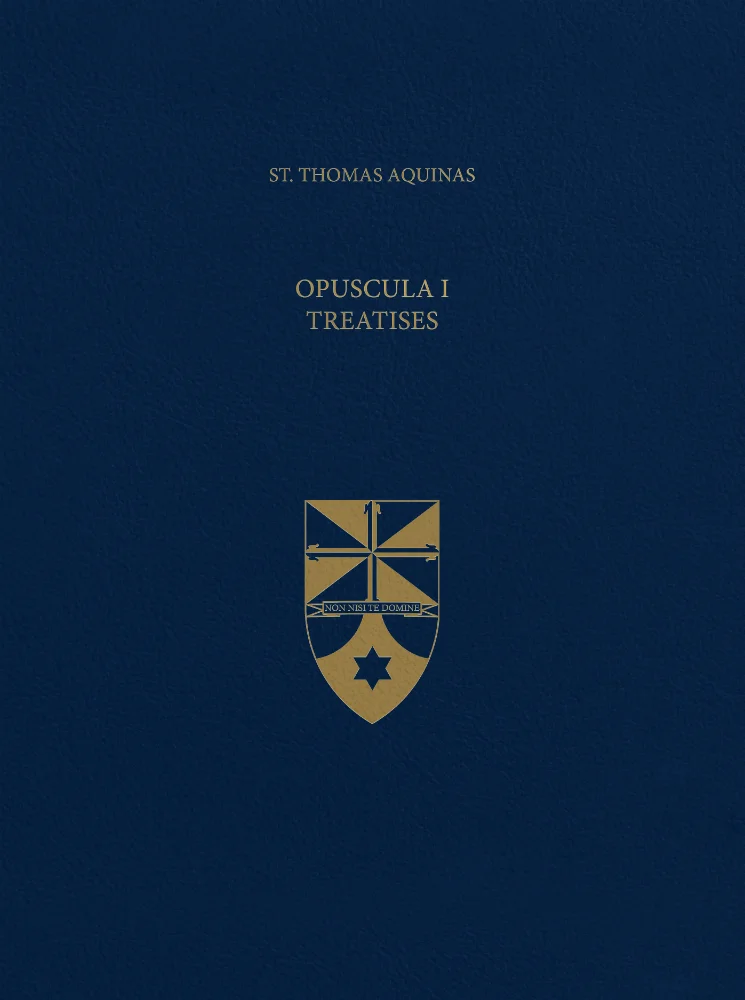
Almost exactly one year ago, the St. Paul Center for Biblical Theology and Emmaus Academic (under the direction of Dr. Scott Hahn) teamed up with the Aquinas Institute, the organization behind the famous opera omnia project led by Dr. John Mortensen. The Thomistic Institute has for several years been working diligently at producing a single complete set of the writings of St. Thomas Aquinas, with Leonine Latin and English translation side-by-side throughout. This particular author recently received a free sample copy of volume number 55—”Opusculum I”—as a gift from the St. Paul Center for review. Of the same series, I already have Aquinas’s biblical commentaries on St. Paul’s letter to the Romans and the gospels of Matthew and John, plus the entire fourth book of his commentary on the Sentences of Peter Lombard.

These volumes are a handful, sizing at about 11.5 inches tall by 8.5 inches wide. They are bound very well and encased within a beautiful blue imitation-leather hardback. The pages feel appropriately thick and almost elegant, with eye-friendly font and dimensions. Finally, there is sufficient marginal space for annotation, especially at the top and bottom of the pages. All in all, this series is splendidly beautiful and easily becomes the envy of any bookshelf, especially after one has compiled a number of volumes.

The most significant aspect of this series, however, is what is found printed on the paper. Not only does this Opera Omnia series provide stunning side-by-side Latin and English of Aquinas’s texts, although that alone would be worthy of attention. No, instead, the real contribution of this series is twofold. First, and most importantly, the Leonine critical Latin edition is made easily accessible to Thomistic scholars in a printed format that will (most likely) fit on office and home bookshelves practically anywhere. This is a major improvement from the opera omnia series that are generally only found as oversized volumes in the reference sections of theological libraries, if they even have them. Second, and quite interestingly, the entirety of Aquinas’s works will be made available in English for the first time ever. It is true that the Aquinas Institute has been relying on several previous English translations to populate their series; however, there are still many works that previously have never been translated beyond a few snippets here and there. Most especially, I am thinking of Aquinas’s massive Commentary on Lombard’s Sentences, but even several of his biblical commentaries, his correspondences, and his lesser known treatises. Because of the availability of the Leonine texts and because of the wave of new English translations, this series marks a major milestone in Thomistic scholarship.

As one can see from the St. Paul Center website, there are only select series available for purchase. A fuller picture of the publication process for individual volumes still in the works can be found on the Aquinas Institute website. Additionally, they have made available many of the texts online at Aquinas.cc. Even though there are still several volumes yet to be published, once the entire series is complete, it will be well worth the wait. In the meantime, there is plenty to enjoy and to use until then!

- Reviewed by Brandon L. Wanless

A comedy in four acts (updated)

After Jean-Luc Marion’s critique of Aquinas as an ontotheologian in L’idole et la distance (1977) and Dieu sans l'être (1982) people made a big deal of an alleged retraction in “Saint Thomas d’Aquin et l'onto-théo-logie” (1995) published in Revue thomiste. The text was even inserted into the 2013 edition of Dieu sans l'être as a supplement. In Marion’s “defense” of Aquinas against the charge of ontotheology in the Revue thomiste article he tells us that we should seriously consider the possibility that the esse that Aquinas predicates of God has no positive content but is purely a nom négatif. Indeed,

pourquoi pretendre le traiter comme un nom affirmatif, fournissant l’équivalent d’une essence, l’équivalent d’une concept, l’équivalent d’une définition, l’équivalent d’une connaissance?

Is this Marion channeling Sertillanges? Is he in earnest or is it all in jest?

I think it was the latter. Marion published an article in a 2004 issue of Conférence in which he argued once again, as he had before 1995, that Aquinas limits God’s transcendence by predicating esse of him.

Marion’s argument in the 2004 piece is weak, to say the least. He begins, harmlessly enough, by explaining that, for Aquinas, God’s esse and essentia aren’t really distinct from each other, as they are in creatures, but identical. This means that God isn’t simply an ens. However, he goes on, this won’t do to ensure God’s transcendence.

Que la transcendance de Dieu ne joue plus à l'intérieur d'un concept d'étant […] ne suffit pas à la libérer; puisqu'elle ne s'ouvre encore que dans l'interstice entre l'essence et l’esse, donc definitivement dans l'horizon de l’être.

It’s unclear whether être here is meant to refer to Heideggerian Sein (which Marion had mentioned in the previous paragraph). If it is, then Sein, being finite (as it surely seems to be), would necessarily limit God’s transcendence were he subject to it. But why should we think that esse and essentia as Aquinas predicates them of God can be reduced to Sein? If this is what Marion has in mind, he doesn’t explain why we should buy it. On the other hand, if être isn't Sein but has a more indefinite reference, why should we think it limits God? Marion doesn’t explain. Of course, we know that Aquinas holds that divine esse is unlimited (cf., e.g., ST, Ia, q. 13, a. 11). If God is without limits, then he can’t help but be transcendent. How does Marion show that Aquinas is wrong to think that divine esse is unlimited? He doesn’t.

The title of the 2004 article is “L’impossible pour l’homme – Dieu.” Marion presented an English version of it at one of John Caputo’s “Religion and Postmodernism” conferences at Villanova. But I don’t remember whether that was before or after the French version appeared.

Several years ago I thought about publishing something about all of this but I never got around to it. Maybe it doesn’t require any drawn-out discussion. The basics can be noted without much ado. In any event, let this blog post suffice for now.

(This is a reblog of a post of mine at the AMU Philosophy Department blog.)

***

Post scriptum (12.7.18): I should make it clear that I do think that, for Aquinas, esse as predicated of God does have some positive content. It’s not merely a negative name, as Marion suggests in the Revue Thomiste article. In the general debate about Aquinas’s apophaticism, I side with Maritain (and Garrigou, Cajetan, and — with some qualifications — Milbank) against Sertillanges.

The "is" that isn't: Heidegger and Aquinas

In Der Satz vom Grund Heidegger writes:

Wenn wir von etwas sagen: “Es ist” und “es ist das und das,” dann wird es im solchen Sagen als Seiendes vorgestellt. Nur Seiendes “ist,” das “ist” selber, das “Sein” “ist” nicht (GA 10, p. 93).

In his commentary on Boethius’s De ebdomadibus Aquinas writes:

[S]icut non possumus dicere quod ipsum currere currat, ita non possumus dicere quod ipsum esse sit; set id quod est significatur sicut subiectum essendi, uelud id quod currit significatur sicut subiectum currendi; et ideo sicut possumus dicere de eo quod currit siue de currente quod currat in quantum subicitur cursui et participat ipsum, ita possumus dicere quod ens siue id quod est sit in quantum participat actum essendi. Et hoc est quod dicit quod ipsum esse nondum est quia non attribuitur sibi esse sicut subiecto essendi, set id quod est, accepta essendi forma, scilicet suscipiendo ipsum actum essendi, est atque consistit, id est in se ipso subsistit (Expositio De ebdomadibus, l. 2; Leonine, L, p. 271).

I truly doubt that Heidegger's Sein is the same thing as Aquinas's esse. There is very good reason (which I won't go into here) to see them as different things. Nevertheless, the parallel between these two texts is interesting and worth thinking about.

Thomism and the death penalty

Edward Feser and Joseph Bessette's new book By Man Shall His Blood Be Shed: A Catholic Defense of the Death Penalty and the Pope's recent remarks on the death penalty have revived the Catholic debate on the topic.

The death penalty has been discussed in several posts here at Thomistica over the years: here, here, here, here, and here. Most of these posts were authored by Steve Long.

On Friday Catholic World Report published an essay of mine entitled "Is opposition to the death penalty Thomistic?" In it I compare Pope Francis's remarks with St. Thomas's teaching. I think the Holy Father's defense of Amoris laetitia as Thomistic encourages this sort of exercise. I also assume that my discussion may be of interest to some of our readers.

Descartes vs. Aquinas (and other scholastics) on the senses, the imagination, God, and the soul

In Summa theologiae, Ia, q. 75, a. 1, Aquinas writes:

[A]d inquirendum de natura animae, oportet praesupponere quod anima dicitur esse primum principium vitae in his quae apud nos vivunt animata enim viventia dicimus, res vero inanimatas vita carentes. Vita autem maxime manifestatur duplici opere, scilicet cognitionis et motus. Horum autem principium antiqui philosophi, imaginationem transcendere non valentes, aliquod corpus ponebant; sola corpora res esse dicentes, et quod non est corpus, nihil esse. Et secundum hoc, animam aliquod corpus esse dicebant.

In Discours de la méthode, AT, 37, Descartes writes:

Mais ce qui fait qu'il y en a plusieurs qui se persuadent qu'il y a de la difficulté à le connaître [i.e., God], et même aussi à connaître ce que c'est que leur âme, c'est qu'ils n'élèvent jamais leur esprit au delà des choses sensibles, et qu'ils sont tellement accoutumés à ne rien considérer qu'en l'imaginant, qui est une façon de penser particulière pour les choses matérielles, que tout ce qui n’est pas imaginable leur semble n'être pas intelligible.

But then, after seeming to express the same insight as Aquinas, Descartes goes on to suggest that people who accept the dictum according to which “n'y a rien dans l'entendement qui n'ait premièrement été dans le sens” (“nihil est in intellectu quod non sit prius in sensu”) have the same problem. Indeed, the dictum itself is an indicator of that problem!

Ce qui est assez manifeste de ce que même les philosophes tiennent pour maxime, dans les écoles, qu'il n'y a rien dans l'entendement qui n'ait premièrement été dans le sens, où toutefois il est certain que les idées de Dieu et de l'âme n'ont jamais été. Et il me semble que ceux qui veulent user de leur imagination, pour les comprendre, font tout de même que si, pour ouïr les sons, ou sentir les odeurs, ils se voulaient servir de leurs yeux : sinon qu'il y a encore cette différence, que le sens de la vue ne nous assure pas moins de la vérité de ses objets, que font ceux de l'odorat ou de l'ouïe; au lieu que ni notre imagination ni nos sens ne nous sauraient jamais assurer d'aucune chose, si notre entendement n'y intervient.

Descartes is either unaware of the scholastic explanation of the dictum (cf. e.g., De veritate, q. 2, a. 3, ad 19) or doesn’t accept it. My hunch is that it’s the latter. But not being an expert on Descartes, I would be glad for help on this.

Praemotio Physica and Predestination

81BmONdB33L.jpg

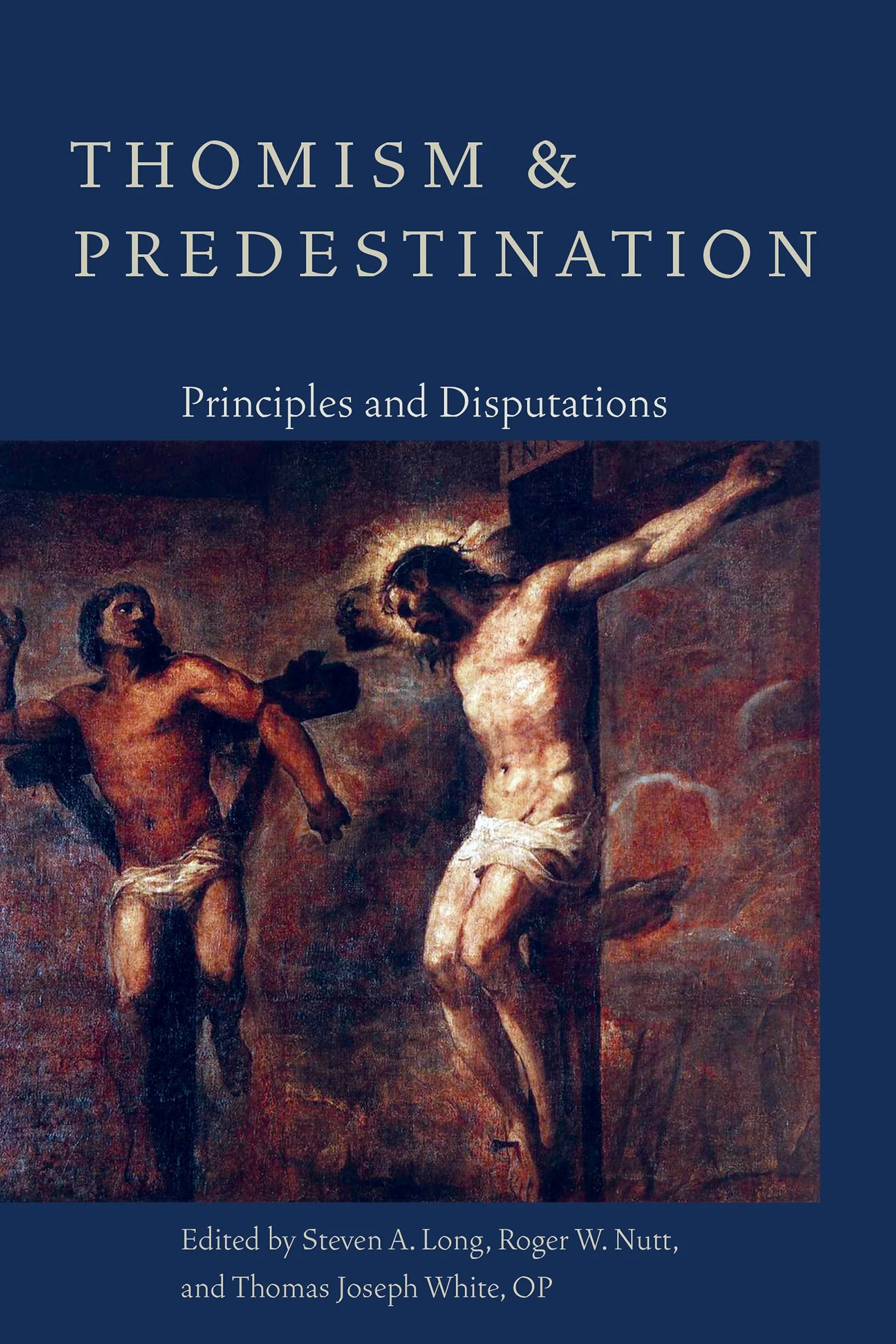
With the arrival of The Catholic University of America Press' Thomism and Predestination: Principles and Disputationsthe questions pertaining to the Angelic Doctor's understanding of predestination and election have once again been brought to the fore of the Thomistic landscape. In looking through the many fine essays that make up this volume, it becomes clear how intimately linked are the questions of physical premotion and predestination. 

Certainly, some may take objection to their relation, especially those who deny that St. Thomas ever held to a doctrine of physical premotion at all. Still, while all Thomists will certainly agree that the grace whereby the elect are chosen (and thus whereby they merit their salvation) is gratuitous, the mechanism of how exactly that grace works to produce the salutary act with the human patient is still hotly disputed.

Many remind us that St. Thomas himself never used the term praemotio physica. While this is certainly true, it is argued by several within this volume that St. Thomas did indeed hold to the doctrine even if he did not explicitly use the term. Steven Long says, "...St. Thomas does affirm that there is a real motion bestowed by God to every creature, a motion that is ontologically prior to any action whatsoever on the part of any creature, including volitional action: and this is what “physical premotion” means. Those who reject the doctrine because Thomas does not use this precise formulation are exhibiting what one might call a semantic ipsissima verba-ism that obstructs their acknowledgment of Thomas’s manifest and express teaching," (pg. 54).

It is indeed true that St. Thomas states unequivocally that, "God moves man to act, not only by proposing the appetible to the senses, or by effecting a change in his body, but also by moving the will itself; because every movement either of the will or of nature, proceeds from God as the First Mover," (ST I-II, q. 6, a. 1, ad 3). Moreover, St. Thomas states, "When anything moves itself, this does not exclude its being moved by another, from which it has even this that it moves itself," (De malo, q. 3, a. 2, ad 4). 

Without the doctrine of physical premotion, questions are immediately raised as to the efficacy of the divine decrees and providential governance over creation. Certainly man participates as a secondary or instrumental cause in his own good action, culminating in the beatific vision for the elect. However, if God is not the primary cause of each and every good act, we may begin to ask whether the elect are distinguished by the grace of God or, conversely, by their own good cooperation with grace, rendering God somehow passive in regard to their distinction and election. 

In so many ways, this new volume on predestination highlights the intimacy between this doctrine of physical premotion and many other facets of the Thomistic theological tradition. In his own essay in the volume, Fr. Serge-Thomas Bonino, O.P. considers how physical premotion necessitates that evil be first permitted by the divine will, otherwise it could not be a part of the divine plan. That God's permission remains non-causal is argued in an essay by Fr. Thomas Joseph White, O.P. It is man who causes his own defect and sin, not God. Thomas Osborne considers how the Thomist ought to understand St. Thomas when he speaks of God causing the being of the sinful act but not that it be sinful. 

Joseph Trabbic explores the doctrine of praemotio physica as it relates to recent objections from Fr. Brian Shanley, O.P. Fr. Christopher Cullen, S.J. elucidates the ways in which premotion aids in a proper reading of St. Ignatius' Spiritual Exercises. 

Of course, not all of the essays in the volume deal explicitly with premotion. Roger Nutt contemplates beautifully an often over-looked aspect of this discussion, namely the central role of the Incarnation of Christ for the mystery of predestination. Also exploring the centrality of the Incarnation, Michael Dauphinais surveys St. Paul's spirit of joy in Ephesians, reminding the reader that God's loving election is a source of Christian hope. Fr. Romanus Cessario, O.P. considers the relation between devotion to Mary and election, especially as contemplated by Louis de Montfort. 

One of the aspects of this volume which will make it most attractive to Thomists of all stripes is the fact that it is a unified conversation with differing voices. The authors found within often disagree as to the fundamental meaning of the doctrines of physical premotion and predestination themselves. Lawrence Feingold presents an essay which tackles the question of the resistance of grace, arguing along similar lines to Jacques Maritain and Francisco Marín-Sola, two figures who certainly disagreed with, for example, Reginald Garrigou-Lagrange, referenced favorably within the volume by Bonino, Trabbic, and others. 

Fr. Matthew Lamb unfolds the thought of Bernard Lonergan, whose own view in regard to premotion is far from the classical definition of physical premotion (a direct working on the will as an exterior principle which moves the will to will.) For Lonergan it is instead something closer to the bringing about of a contactus or proximity between two created beings which are already created and preserved in act, allowing one to act upon the other as cause of some effect.

Barry David considers the quantitative scope of salvation, arguing against St. Thomas that the assertion of a minority salvation mitigates the divine goodness. Michael Waldstein spars charitably with the thought of his friend and colleague Steven Long over Hans Urs von Balthasar, pure nature, and its relation to man's ordering to his supernatural end of beatitude. 

While each essay is worthy of speculation and contemplation, the most valuable character of the work is its discussion as a whole. At the center of any of the fruitful tensions, disagreements, and even concurrences between the individual essays is a sign of the Thomistic project once again collectively picking up these difficult but central questions.

Much of that discussion deals, at its core, with the way in which God causes the beatitude of His chosen, a fundamental theological principle for all Thomists. The differing understandings of physical premotion and its relation to human freedom and evil are certainly at the center of this fecund project. Each essay, whether it explicitly deals with premotion or not, is an important comment and addition to the Thomistic tradition on the nature of that doctrine. As such, while the volume addresses a myriad of issues and their relation to the mystery of predestination, it is an important contemporary consideration of praemotio physica. It is a must-read for anyone who is at all interested in predestination or the human dependence upon God for the good acts which are predestination's effect.

- Reviewed by Taylor Patrick O’Neill

Aquinas's use of the lex parsimoniae

We all know that Ockham's razor wasn't really Ockham's razor. He got the shaving device second hand from his predecessors, among them, Aquinas.

Below are some instances of Aquinas's use of it, which I have shamelessly lifted from Schütz's Lexikon. Schütz lists them in the entry for fieri (and you'll see why). I came across them last week and I thought it would be handy to gather them here for anyone who is interested in the topic.

Three things to note: (1) Of the instances from the Contra gentiles and the Summa theologiae below (which are all the instances save one), almost all are found in objections. The only one that isn't from an objection is the one from CG, I, 42 (the first one). (2) The instance from the commentary on the Physics (the last one) is used in explicating Aristotle's argument. (3) I made minor changes to the wording and punctuation of the second and last ones since I noticed discrepancies with the Leonine text.

Don't cut yourself!

*** 

quod sufficienter fit uno posito, melius est per unum fieri, quam per multa (CG, I, 42)  

quod potest sufficienter fieri per unum, superfluum est si per multa fiat (CG, III, 70)

quod potest compleri per pauciora principia, non fit per plura (ST, I, a. 2, arg. 2)

quod potest sufficienter fieri per unum, superfluum est, quod fiat per multa (ST, I, q. 108, a. 3, arg. 2)

quod sufficienter potest fieri per unum, non oportet, quod per aliquid aliud inducatur (ST, II-II, q. 22, q. 1, arg. 1)

quod potest fieri per unum, superfluum est plura ponere (ST, II-II, q. 45, a. 2, arg. 3)

quod potest fieri per unum, superflue fit per multos (ST, III, q. 82, a. 2, arg. 2)

Quod potest fieri per pauciora, superfluum est si fiat per plura (In Physic., I, l. 11, n. 14)

Common natures in God's mind: A response to Bill Vallicella

Bill Vallicella poses the following problem

Consider a time t before there were any human animals and any finite minds, and ask yourself: did the nature humanity exist at t?

Vallicella points out that, for Aquinas, the answer would be that at t humanity existed in God’s mind. He comments on Aquinas’s answer thus:

This may seem to solve the problem I raised.  Common natures are not nothing because they are divine accusatives.  And they are not nothing in virtue of being ausserseiend. This solution avoids the three options of Platonism, subjectivism (according to which CNs exist only as products of abstraction), and Meinongianism.

What Vallicella is talking about here, of course, is Aquinas's doctrine of divine ideas. But he isn’t satisfied with the solution this doctrine offers.

The problem with the solution is that it smacks of deus ex machina: God is brought in to solve the problem similarly as Descartes had recourse to the divine veracity to solve the problem of the external world.  Solutions to the problems of universals, predication, and intentionality ought to be possible without bringing God into the picture.

I don’t see any reason to concede this deus ex machina (DEM) objection against Aquinas's doctrine. Why ought solutions to the problems of universals, predication, and intentionality to be possible without bringing God into the picture? Vallicella doesn’t say.  What if I instructed you in the following way: “Solve the problem of human knowledge without appealing to an immaterial intellect”? You could legitimately ask why I’ve barred the path of inquiry in this way. What if our reflection on the evidence indicated that an immaterial intellect had to be a part of the solution? (If you’re a naturalist, suppose I tell you to solve the problem of human knowledge without appealing to the brain.) Vallicella needs to explain why God can’t be involved in the solution of the above problems.

Vallicella references an earlier post where he considers what’s wrong with arguments that rely on a DEM. Let's look at this post to see if we can find out why he wishes to object to Aquinas in the way he does.

Vallicella suggests in this post five possible ways to understand what is meant by the DEM charge when it is leveled in philosophy. Vallicella’s DEM catalogue, however tentative, is very useful and appears to fill in a gap in the literature. Here are the possibilities he proposes:

(1) Any appeal to a supernatural agent in a theory of natural phenomena is a DEM.

(2)  An appeal to a supernatural agent in a theory of natural phenomena is a DEM iff no independent reasons are given for the existence of the supernatural agent.

(3)  An appeal to a supernatural agent in a theory of natural phenomena is a DEM iff no reasons are supplied for the existence of the divine agent.

(4)  An appeal to a supernatural agent in a theory of natural phenomena is a DEM iff EITHER no reasons are supplied for the existence of the divine agent, OR the working of the agent violates natural laws.

(5)  An appeal to a supernatural agent in a theory of natural phenomena is a DEM iff EITHER no reasons are supplied for the existence of the divine agent, OR the working of the agent violates natural laws, OR the agent’s intervention in nature is miraculous in the sense in that it takes over a job that ought to be done by a natural entity.

Vallicella doesn’t think we should a priori rule out arguments to God as the cause of natural phenomena. So, he says that (1) can’t be what a DEM is. (Actually, he doesn't argue exactly like this but this is how I interpret him.)

Vallicella also concludes that (2) can’t be what a DEM is. Here's how he explains its flaw:

Why would the reasons for the supernatural agent have to be independent, i.e., independent of the job the agent is supposed to do? Suppose the appeal to a divine agent takes the form of an inference to the best or the only possible explanation of the natural explananda. Then the appeal to the divine agent would be rationally justified despite the fact that the agent is posited to do a specific job.

I’m not quite sure what Vallicella’s view of (3) is. He seems to think that it constitutes a DEM but isn't the only form it can take. It can also take the form of (4) and (5).

But if we construe DEM as (3), (4), or (5), Aquinas's doctrine of divine ideas isn't conspicuously guilty of DEM. Aquinas doesn't fail to offer reasons for the existence of the divine agent whose mind contains the ideas (cf. ST, Ia, 2, 3). There is no obvious way that the doctrine of divine ideas violates natural laws (presumably the laws of the physical world that the natural sciences investigate). And, finally, it doesn't give a job to God that ought to be done by a natural entity.

With respect to the last point, Aquinas takes the divine ideas to be God's understanding of his essence as imitable by any creature (cf. ST, Ia, 15, 2). No natural entity as such could have God's understanding of his essence. Ergo, God isn't doing a job some natural entity should do, for no natural entity could do it.

So, I'm perplexed by Vallicella's suggestion that Aquinas's doctrine of divine ideas is an instance of DEM.

Vallicella is a careful, sharp thinker, so I assume that I have misunderstood him or he has only incompletely expressed himself. It’s possible that we do simply disagree but I suspect that the point of disagreement has not yet been identified.