Praemotio Physica and Predestination

81BmONdB33L.jpg

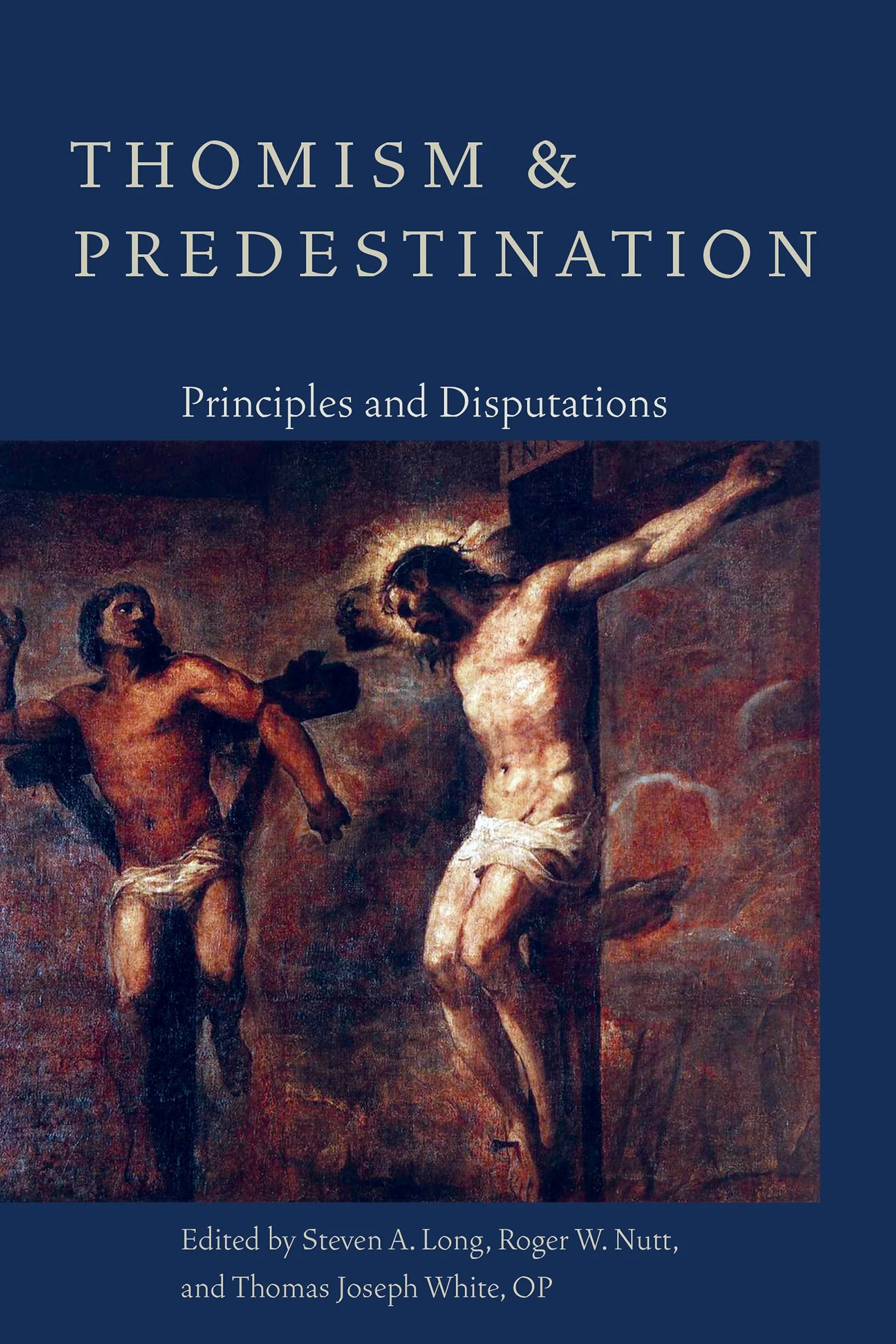
With the arrival of The Catholic University of America Press' Thomism and Predestination: Principles and Disputationsthe questions pertaining to the Angelic Doctor's understanding of predestination and election have once again been brought to the fore of the Thomistic landscape. In looking through the many fine essays that make up this volume, it becomes clear how intimately linked are the questions of physical premotion and predestination. 

Certainly, some may take objection to their relation, especially those who deny that St. Thomas ever held to a doctrine of physical premotion at all. Still, while all Thomists will certainly agree that the grace whereby the elect are chosen (and thus whereby they merit their salvation) is gratuitous, the mechanism of how exactly that grace works to produce the salutary act with the human patient is still hotly disputed.

Many remind us that St. Thomas himself never used the term praemotio physica. While this is certainly true, it is argued by several within this volume that St. Thomas did indeed hold to the doctrine even if he did not explicitly use the term. Steven Long says, "...St. Thomas does affirm that there is a real motion bestowed by God to every creature, a motion that is ontologically prior to any action whatsoever on the part of any creature, including volitional action: and this is what “physical premotion” means. Those who reject the doctrine because Thomas does not use this precise formulation are exhibiting what one might call a semantic ipsissima verba-ism that obstructs their acknowledgment of Thomas’s manifest and express teaching," (pg. 54).

It is indeed true that St. Thomas states unequivocally that, "God moves man to act, not only by proposing the appetible to the senses, or by effecting a change in his body, but also by moving the will itself; because every movement either of the will or of nature, proceeds from God as the First Mover," (ST I-II, q. 6, a. 1, ad 3). Moreover, St. Thomas states, "When anything moves itself, this does not exclude its being moved by another, from which it has even this that it moves itself," (De malo, q. 3, a. 2, ad 4). 

Without the doctrine of physical premotion, questions are immediately raised as to the efficacy of the divine decrees and providential governance over creation. Certainly man participates as a secondary or instrumental cause in his own good action, culminating in the beatific vision for the elect. However, if God is not the primary cause of each and every good act, we may begin to ask whether the elect are distinguished by the grace of God or, conversely, by their own good cooperation with grace, rendering God somehow passive in regard to their distinction and election. 

In so many ways, this new volume on predestination highlights the intimacy between this doctrine of physical premotion and many other facets of the Thomistic theological tradition. In his own essay in the volume, Fr. Serge-Thomas Bonino, O.P. considers how physical premotion necessitates that evil be first permitted by the divine will, otherwise it could not be a part of the divine plan. That God's permission remains non-causal is argued in an essay by Fr. Thomas Joseph White, O.P. It is man who causes his own defect and sin, not God. Thomas Osborne considers how the Thomist ought to understand St. Thomas when he speaks of God causing the being of the sinful act but not that it be sinful. 

Joseph Trabbic explores the doctrine of praemotio physica as it relates to recent objections from Fr. Brian Shanley, O.P. Fr. Christopher Cullen, S.J. elucidates the ways in which premotion aids in a proper reading of St. Ignatius' Spiritual Exercises. 

Of course, not all of the essays in the volume deal explicitly with premotion. Roger Nutt contemplates beautifully an often over-looked aspect of this discussion, namely the central role of the Incarnation of Christ for the mystery of predestination. Also exploring the centrality of the Incarnation, Michael Dauphinais surveys St. Paul's spirit of joy in Ephesians, reminding the reader that God's loving election is a source of Christian hope. Fr. Romanus Cessario, O.P. considers the relation between devotion to Mary and election, especially as contemplated by Louis de Montfort. 

One of the aspects of this volume which will make it most attractive to Thomists of all stripes is the fact that it is a unified conversation with differing voices. The authors found within often disagree as to the fundamental meaning of the doctrines of physical premotion and predestination themselves. Lawrence Feingold presents an essay which tackles the question of the resistance of grace, arguing along similar lines to Jacques Maritain and Francisco Marín-Sola, two figures who certainly disagreed with, for example, Reginald Garrigou-Lagrange, referenced favorably within the volume by Bonino, Trabbic, and others. 

Fr. Matthew Lamb unfolds the thought of Bernard Lonergan, whose own view in regard to premotion is far from the classical definition of physical premotion (a direct working on the will as an exterior principle which moves the will to will.) For Lonergan it is instead something closer to the bringing about of a contactus or proximity between two created beings which are already created and preserved in act, allowing one to act upon the other as cause of some effect.

Barry David considers the quantitative scope of salvation, arguing against St. Thomas that the assertion of a minority salvation mitigates the divine goodness. Michael Waldstein spars charitably with the thought of his friend and colleague Steven Long over Hans Urs von Balthasar, pure nature, and its relation to man's ordering to his supernatural end of beatitude. 

While each essay is worthy of speculation and contemplation, the most valuable character of the work is its discussion as a whole. At the center of any of the fruitful tensions, disagreements, and even concurrences between the individual essays is a sign of the Thomistic project once again collectively picking up these difficult but central questions.

Much of that discussion deals, at its core, with the way in which God causes the beatitude of His chosen, a fundamental theological principle for all Thomists. The differing understandings of physical premotion and its relation to human freedom and evil are certainly at the center of this fecund project. Each essay, whether it explicitly deals with premotion or not, is an important comment and addition to the Thomistic tradition on the nature of that doctrine. As such, while the volume addresses a myriad of issues and their relation to the mystery of predestination, it is an important contemporary consideration of praemotio physica. It is a must-read for anyone who is at all interested in predestination or the human dependence upon God for the good acts which are predestination's effect.

- Reviewed by Taylor Patrick O’Neill

Does Aquinas think that God participates in being?

Of course not!

And yet some people -- who apparently have either not read Aquinas or not read him carefully -- persist in thinking that he holds that God (along with creatures) is a participant in being. You can find this, for example, in some Barthians (and perhaps even in Barth himself).

Consider this passage from Angela Dienhart Hancock's recent book on Barth:

The analogia entis, a scholastic term famously formulated by Thomas Aquinas, means that God and human beings (and all creation) are similar in that they participate in something called “being.” Hence we can figure out what God is like by looking at the created order, because everything is connected to everything else in the great chain of being, which stretches all the way up to being itself (God) (Karl Barth’s Emergency Homiletic, 1932-1933: A Summons to Prophetic Witness at the Dawn of the Third Reich, p. 186, n. 142).

Three things. First, I have never found the term analogia entis in Aquinas's writings. I do not deny that the idea is there formally (although not in the way suggested by Prof. Dienhart Hancock). I only say that I have not been able to find the term itself. Second, if God is being, as is suggested at the end of the above passage, how can he participate in being? Third, the first sentence, as a statement about Aquinas's doctrine is simply false.

There are many places where Aquinas makes his doctrine clear. One such place is this passage from the commentary on the Sentences:

[C]reator et creatura reducuntur in unum, non communitate univocationis sed analogiae. Talis autem communitas potest esse dupliciter. Aut ex eo quod aliqua participant aliquid unum secundum prius et posterius, sicut potentia et actus rationem entis, et similiter substantia et accidens; aut ex eo quod unum esse et rationem ab altero recipit, et talis est analogia creaturae ad creatorem: creatura enim non habet esse nisi secundum quod a primo ente descendit: unde nec nominatur ens nisi inquantum ens primum imitatur; et similiter est de sapientia et de omnibus aliis quae de creatura dicuntur (Prol. q. 1, a. 2, ad 2). (The Creator and the creature are reduced to unity not by a univocal commonality but by analogy. Now, such a commonality can be twofold. It can either be because certain things participate in something according to an order of priority and posteriority, as potency and act participate in the concept of being as also substance and accident do; or this commonality can be because a thing receives its being and its concept from another, and such is the analogy between creature and Creator. In fact, the creature only has being insofar as it descends from the first being [i.e., God]. Thus, it is only called being because it imitates the first being. And the same must be said of wisdom and everything else that is said of creatures.)

What more needs to be said?