Praemotio Physica and Predestination

81BmONdB33L.jpg

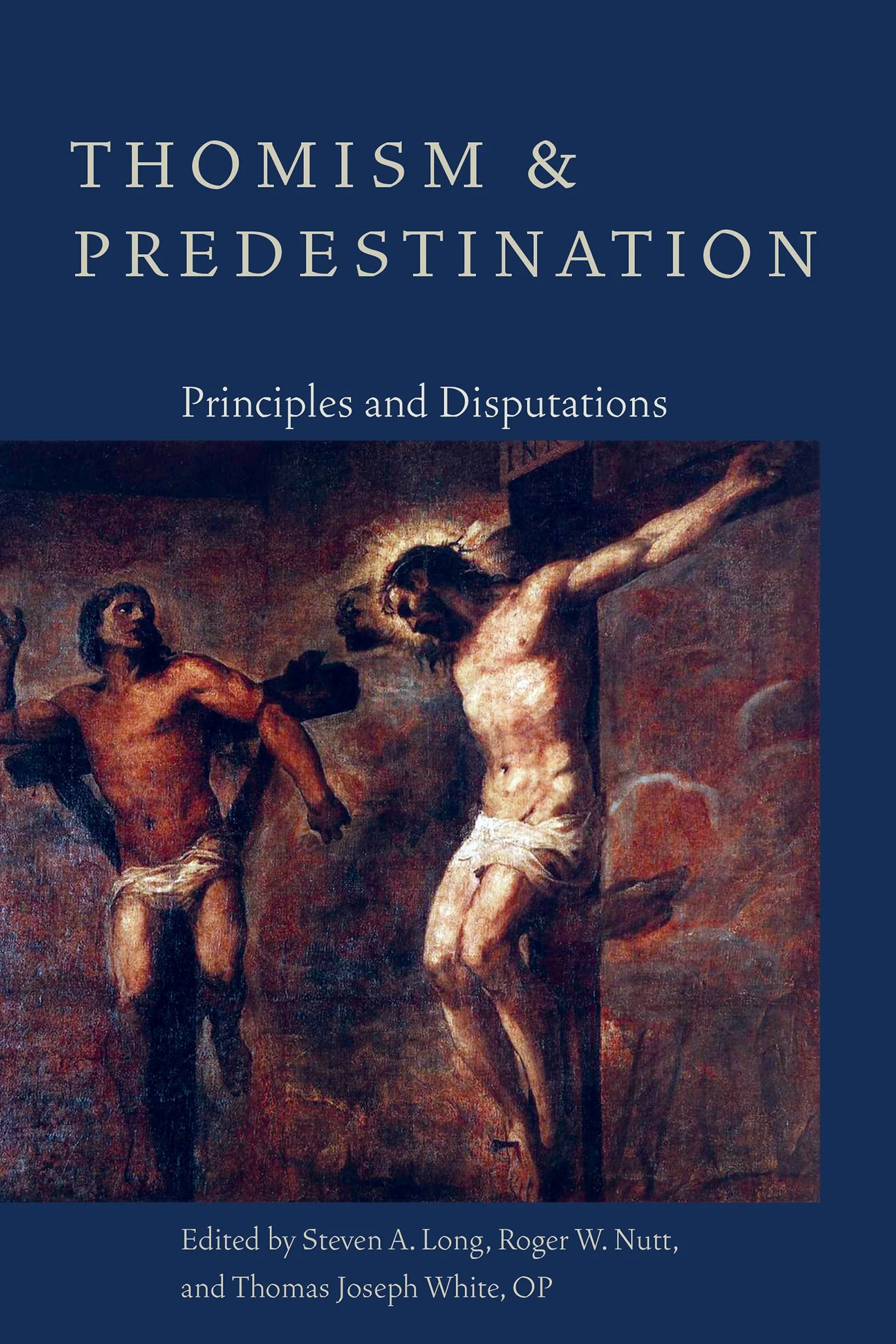
With the arrival of The Catholic University of America Press' Thomism and Predestination: Principles and Disputationsthe questions pertaining to the Angelic Doctor's understanding of predestination and election have once again been brought to the fore of the Thomistic landscape. In looking through the many fine essays that make up this volume, it becomes clear how intimately linked are the questions of physical premotion and predestination. 

Certainly, some may take objection to their relation, especially those who deny that St. Thomas ever held to a doctrine of physical premotion at all. Still, while all Thomists will certainly agree that the grace whereby the elect are chosen (and thus whereby they merit their salvation) is gratuitous, the mechanism of how exactly that grace works to produce the salutary act with the human patient is still hotly disputed.

Many remind us that St. Thomas himself never used the term praemotio physica. While this is certainly true, it is argued by several within this volume that St. Thomas did indeed hold to the doctrine even if he did not explicitly use the term. Steven Long says, "...St. Thomas does affirm that there is a real motion bestowed by God to every creature, a motion that is ontologically prior to any action whatsoever on the part of any creature, including volitional action: and this is what “physical premotion” means. Those who reject the doctrine because Thomas does not use this precise formulation are exhibiting what one might call a semantic ipsissima verba-ism that obstructs their acknowledgment of Thomas’s manifest and express teaching," (pg. 54).

It is indeed true that St. Thomas states unequivocally that, "God moves man to act, not only by proposing the appetible to the senses, or by effecting a change in his body, but also by moving the will itself; because every movement either of the will or of nature, proceeds from God as the First Mover," (ST I-II, q. 6, a. 1, ad 3). Moreover, St. Thomas states, "When anything moves itself, this does not exclude its being moved by another, from which it has even this that it moves itself," (De malo, q. 3, a. 2, ad 4). 

Without the doctrine of physical premotion, questions are immediately raised as to the efficacy of the divine decrees and providential governance over creation. Certainly man participates as a secondary or instrumental cause in his own good action, culminating in the beatific vision for the elect. However, if God is not the primary cause of each and every good act, we may begin to ask whether the elect are distinguished by the grace of God or, conversely, by their own good cooperation with grace, rendering God somehow passive in regard to their distinction and election. 

In so many ways, this new volume on predestination highlights the intimacy between this doctrine of physical premotion and many other facets of the Thomistic theological tradition. In his own essay in the volume, Fr. Serge-Thomas Bonino, O.P. considers how physical premotion necessitates that evil be first permitted by the divine will, otherwise it could not be a part of the divine plan. That God's permission remains non-causal is argued in an essay by Fr. Thomas Joseph White, O.P. It is man who causes his own defect and sin, not God. Thomas Osborne considers how the Thomist ought to understand St. Thomas when he speaks of God causing the being of the sinful act but not that it be sinful. 

Joseph Trabbic explores the doctrine of praemotio physica as it relates to recent objections from Fr. Brian Shanley, O.P. Fr. Christopher Cullen, S.J. elucidates the ways in which premotion aids in a proper reading of St. Ignatius' Spiritual Exercises. 

Of course, not all of the essays in the volume deal explicitly with premotion. Roger Nutt contemplates beautifully an often over-looked aspect of this discussion, namely the central role of the Incarnation of Christ for the mystery of predestination. Also exploring the centrality of the Incarnation, Michael Dauphinais surveys St. Paul's spirit of joy in Ephesians, reminding the reader that God's loving election is a source of Christian hope. Fr. Romanus Cessario, O.P. considers the relation between devotion to Mary and election, especially as contemplated by Louis de Montfort. 

One of the aspects of this volume which will make it most attractive to Thomists of all stripes is the fact that it is a unified conversation with differing voices. The authors found within often disagree as to the fundamental meaning of the doctrines of physical premotion and predestination themselves. Lawrence Feingold presents an essay which tackles the question of the resistance of grace, arguing along similar lines to Jacques Maritain and Francisco Marín-Sola, two figures who certainly disagreed with, for example, Reginald Garrigou-Lagrange, referenced favorably within the volume by Bonino, Trabbic, and others. 

Fr. Matthew Lamb unfolds the thought of Bernard Lonergan, whose own view in regard to premotion is far from the classical definition of physical premotion (a direct working on the will as an exterior principle which moves the will to will.) For Lonergan it is instead something closer to the bringing about of a contactus or proximity between two created beings which are already created and preserved in act, allowing one to act upon the other as cause of some effect.

Barry David considers the quantitative scope of salvation, arguing against St. Thomas that the assertion of a minority salvation mitigates the divine goodness. Michael Waldstein spars charitably with the thought of his friend and colleague Steven Long over Hans Urs von Balthasar, pure nature, and its relation to man's ordering to his supernatural end of beatitude. 

While each essay is worthy of speculation and contemplation, the most valuable character of the work is its discussion as a whole. At the center of any of the fruitful tensions, disagreements, and even concurrences between the individual essays is a sign of the Thomistic project once again collectively picking up these difficult but central questions.

Much of that discussion deals, at its core, with the way in which God causes the beatitude of His chosen, a fundamental theological principle for all Thomists. The differing understandings of physical premotion and its relation to human freedom and evil are certainly at the center of this fecund project. Each essay, whether it explicitly deals with premotion or not, is an important comment and addition to the Thomistic tradition on the nature of that doctrine. As such, while the volume addresses a myriad of issues and their relation to the mystery of predestination, it is an important contemporary consideration of praemotio physica. It is a must-read for anyone who is at all interested in predestination or the human dependence upon God for the good acts which are predestination's effect.

- Reviewed by Taylor Patrick O’Neill

Thomistic political philosophy and religious freedom

Two years ago I published a two-part interview on this blog with Raymond Dennehy on Maritain's political philosophy (here and here). In particular it was about a couple books by Maritain that were being reissued, Christianity and Democracy and The Rights of Man and the Natural Law. I had entitled the interview "The return of Thomistic political philosophy." In the comments box John Lamont wrote: "Reprinting Maritain's work is in no way a revival of Thomistic political philosophy, because Maritain's thought was completely different from that of St. Thomas in this area." I tend to think that Dr. Lamont's criticism was justified. I posted twice more on this topic (here and here), taking a rather harsh line toward Maritain's political thought -- not that I had not been skeptical of it prior to considering Dr. Lamont's objection. Quite the contrary is true. The issue was not whether Maritain's political thought had problems but whether it could properly be called "Thomistic."

In this present post I ask what an authentically Thomistic approach would be to the problem of religious freedom. Religious freedom is especially on the minds of many Catholics in the U.S. now as Catholic institutions fight against the H.H.S. mandate. But it seems to be a topic of perennial importance.

Anyhow, I would say that it is obvious that no ostensibly Thomistic political thought would accept the notion that all religions have an equal right publicly to teach and practice their beliefs. This would not mean that it would not be prudent in many circumstances to tolerate false religions nor does it take a stand on what would be permissible in private. Recently, I have tried to articulate my thoughts on these questions in a short essay. The essay focuses on Dignitatis Humanae but also incorporates Aquinas on a key point. Here are some relevant excerpts from the essay:

In the Catholic tradition religion is considered a moral virtue falling under justice. This understanding of religion can be found, for instance, in Aquinas and, more recently, in the Catechism of the Catholic Church. For Aquinas, religion is fundamentally rendering the true God the honor that is due him. The Catechism sees the moral virtue of religion in a similar way.

As with all virtues, religion has corresponding vices. According to Aquinas, the opposite of religion is superstition, the offering of worship to whomever or whatever does not deserve it. Idolatry, for Aquinas, is a species of superstition. The Catechism too treats the vices of superstition and idolatry, although what Aquinas says about these appears to be dealt with in the Catechism solely under the heading of idolatry. Idolaters, the Catechism tells us, “venerate other divinities than the one true God.”

If religion as a moral virtue honors the one true God, then religions that do not are not truly religions or could justly be called false or defective religions. This is not to say that they contain no elements of truth. It is rather to say that their orthodox practice and teaching, taken as a whole and objectively considered, do not lead to God. To follow or promote religions of this sort would be to act against the moral law. This consideration evidently raises more and deeper problems for religious freedom.

[...]

But if false religions run contrary to objective moral order—as they must if they are moral vices, as we have observed—then, in principle, only prudent toleration could prevent legislation against them. In other words, there is no absolute right to follow and teach a false religion. By “absolute right” I mean one that cannot in any circumstances be legitimately violated. An “absolute right” would be a right that accrues to us simply by virtue of being human persons. You could call it a “human” or “natural right.” Such a right would transcend all cultures and political communities, requiring recognition by all. That can not be true for adherents of false religion.

If false religion is a moral vice, plainly no one has any natural right to practice it, for no one can have a right to do evil. Were there a natural right to do evil, there could not be a natural moral law that bound us to do good. We certainly are not naturally bound to do good if we have a natural right to do evil.

I would be grateful for feedback on my essay from readers.

Of course, you may query whether the "authentically Thomistic approach" to religious freedom is also the right approach. I would argue that it is and would be happy to pursue a discussion of its validity at some point in the future. No doubt there are also some who would wonder whether what I am calling the authentically Thomistic approach to religious freedom really is just that. I would welcome that discussion too.

The evolution of Maritain's later political thought

I recently reviewed a book on Jacques Maritain’s political theory for The Catholic Historical Review. The book is by Daniele Lorenzini and is entitled Jacques Maritain e i diritti umani: Fra totalitarismo, antisemitismo e decmocrazia (1936–1951). It was published last year by Morcelliana. Since I have posted on Maritain’s political theory (of which I am a critic) in the past on Thomistica (here, here, here, and here) I thought that I would offer some excerpts in the present post from my review.

Here’s the first paragraph:

This is an historical rather than philosophical investigation of Jacques Maritain’s political thought, although it should be of interest to anyone who studies this dimension of Maritain’s work. Lorenzini’s central thesis is that there is a significant development in Maritain’s political thought with respect to human rights between Humanisme intégral (Paris, 1936) and his writings during and after World War II, a development that was probably affected in some manner by the French philosopher’s collaboration with the Committee of Catholics for Human Rights [=CCHR] in the United States and its review, The Voice for Human Rights. The earlier development in Maritain’s political thought between his support of the French monarchist movement Action Française and his shift toward a more liberal position is well known. But the later development, treated by Lorenzini in his book, seems not to have received so much attention.

Here are my comments on the second chapter, which is the heart of the book:

The second and longest chapter charts the development in Maritain’s political theory from Humanisme intégral of 1936 to his publications and speeches on political themes in 1943. Lorenzini notes that in Humanisme intégral, although Maritain does open the door to a politically defined social pluralism, he is not yet prepared to defend a human right to practice a non-Christian religion or to follow a non-Christian way of life.The pluralism supported by Maritain in this text is one based on a politically prudent tolerance. Although Maritain does elaborate a theory of “rights of the human person,”he avoids the language of “human rights” or the “rights of man” during this period.The latter language found its way into Maritain’s work for the first time in 1939, in the draft of “The Conquest of Freedom” (subsequently published in 1940). According to Lorenzini, behind the lexical difference there was, for Maritain, a philosophical and theological difference. Talk of the rights of the human person was linked to the Christian understanding of man as created by God, whereas the language of human rights and the rights of man was linked with the secular political theory of the Enlightenment, especially Jean-Jacques Rousseau. Lorenzini contends that Maritain’s experience with the [CCHR] and of the evil of fascism during the war led him to rethink his approach to rights and finally to work out a reconciliation in his own thought between a Christian political vision and the political legacy of the Enlightenment, a reconciliation made clear by the title of his book Les droits de l’homme et la loi naturelle (New York, 1942).

Lorenzini’s tone and judgments in the book suggest that he is sympathetic with Maritain’s political theory. The book seems important to me for its account of the evolution in Maritain’s later political thought on human rights, which, as far as I am aware, has not been much discussed.

In my view this evolution in Maritain’s later political thought is a decline. The position in Humanisme intégral on toleration vs. rights seems more sensible to me. That is not to say that I endorse Humanisme intégral as a whole.

[This post also appears in more or less the same form at the AMU philosophy department blog.]