
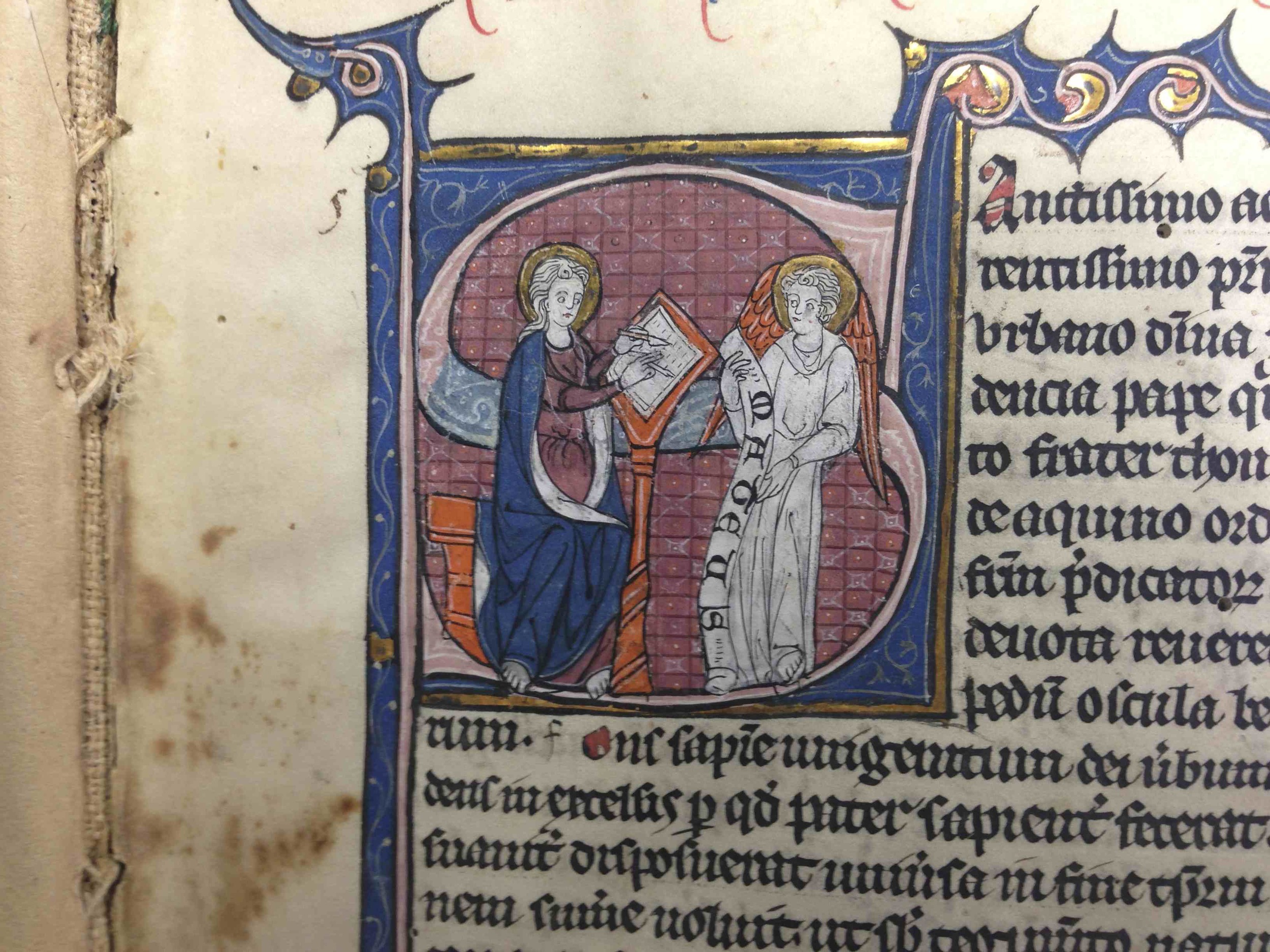
International Paperback Edition of Aquinas’s Opera Omnia
/The Aquinas Institute now has available a paperback edition of the Opera Omnia of St. Thomas Aquinas.
Read MoreThe Aquinas Institute now has available a paperback edition of the Opera Omnia of St. Thomas Aquinas.
Read More2024 marks the 750th anniversary of the death of both Bonaventure of Bagnoregio and Thomas Aquinas. To commemorate the occasion, the Centre of Philosophy of the University of Lisbon (CFUL), in partnership with the Center for Classical Studies of the same University (CEC), the Society for the European History of Ideas (SEHI), and the Red Latinoamericana de Filosofía Medieval (RLFM), is organizing a colloquium.
Read MoreJoin us for an engaging two-day discussion of the intellectual contributions of the Oxford Dominicans of the last century.
Read MoreJoin us this summer at our sunny California campus to enjoy lectures, conversations, and fellowship as we explore the theme of “Virtue, Law, and the Common Good” together with Dr. Christopher Kaczor, Dr. Michael Pakaluk, Fr. Sebastian Walshe, and Dr. John Goyette.
Read MoreFor Saint Thomas Aquinas, the notion of law is situated within a broader metaphysical and theological context, which modern theories of law have largely abandoned. In order to recover the wisdom of Saint Thomas on the topic of law, the 2024 Rome seminar will consider this question: what is the relationship between grace, virtue, and law?
Read MoreOccasioned by the 25th anniversary of Fides et Ratio, this volume seeks to collect a series of original contributions on the Sedes Sapientiae as a model for true philosophy, as suggested by the encyclical’s final paragraph. The goal is to traverse the profound dialogue between philosophical inquiry and Marian themes, fostering a multidisciplinary discourse at the intersection of Philosophy and Mariology.
Read MoreThe priority deadline for proposals to the 2024 Sacra Doctrina Project Conference is approaching. Priority consideration will be given to proposals received by December 15, 2023, while the final deadline is January 1, 2024.
Read MoreThe Honors College and the Department of Philosophy and Religion at the University of Tulsa invite graduate students to submit paper proposals for a conference honoring the 750th anniversary of the death of St. Thomas Aquinas to be held 7-9 March 2024 on the campus of the University of Tulsa. This conference will gather Theologians, Philosophers, Historians, and other interested scholars to mark this anniversary.
Read MoreUND has recently announced the availability of small grants for international and nationally based scholars during Summer of 2024. Please see https://historyofphilosophy.nd.edu/grants for more details.
Read MoreThe AMA welcomes papers approaching the issue of the promise and peril of democracy from any philosophical perspective that complements and enriches our understanding of the issues. We also invite papers on a secondary theme, honoring the 750th anniversary of the deaths of St. Thomas Aquinas and St. Bonaventure in 1274.
Read MoreThe VII Symposium Thomisticum will be held in Vienna, 6-8 June 2024.

The theme is Aquinas in History.
Papers which relate St Thomas either to one or more of his sources or subsequent influences are welcome.
Details at http://www.symposiumthomisticum.com
The following is the list of intending speakers. Brackets indicate provisional:
(Vivian Boland OP), Janice Breidenbach, Michael Breidenbach, Brian Carl, Thérèse Scarpelli Cory, (John Cottingham), Daniel De Haan, Gregory Doolan, Kevin Flannery SJ, (Simon Francis Gaine OP), Lloyd Gerson, (Harm Goris), (John Haldane), Joshua Hochschild, (Piotr Jaroszynski), Mark Johnson, Gaven Kerr, Gyula Klima, Katja Krause, Reginald Lynch OP, Siobhan Nash-Marshall, Rupert Mayer OP, (John O’Callaghan), Paul O’Grady, Thomas Osborne, Michael Pakaluk, (Eric Perl), Günther Pöltner, Thomas Prügl, Alice Ramos, (Fáinche Ryan), Richard Schenk OP, Michael Sherwin OP, David Twetten, Giovanni Ventimiglia, Jörgen Vijgen, Thomas Joseph White OP, (Rudi Te Velde).
Papers are invited for parallel supplementary sessions on the afternoon of 8 June. Please submit abstractsas soon as possible but no later than 29 February. It may be necessary to limit the number of presentations.
Complete papers should be submitted by 1 May.
Papers will be circulated in advance; summaries will be presented at the symposium: papers will be discussed rather than read.
Registration of €200 euro will include refreshments, buffet dinner on the first evening, and conference dinner on Saturday.
All inquiries to Fran O'Rourke, Emeritus Professor of Philosophy, University College Dublin (orourke@ucd.ie).
Dionysius’s Analogous Participation in God: A Hierarchical Tapestry of Being
The notion of “analogous participation in God” plays a fundamental role in the writings of Pseudo-Dionysius the Areopagite. This thematic session proposes to explore this concept as it appears in the original corpus, in addition to its treatment by later authors, e.g., Maximus the Confessor and Thomas Aquinas.
For Dionysius, something exists only to the extent that it participates in God (DN IV.7). Yet participation across creation is not uniform. It is analogous, varying according to the entity’s specific mode of existence (DN II.5.641D; DN IV.1, 693B). Further, Dionysius conceives the being of every entity as the presence or illumination of God (DN I.3, 589C). Thus, in virtue of these “illuminations analogous” (DN I.2, 588CD), which are hierarchically arranged, God’s diverse creation is the universal shining forth of the one God.
This session will explore the following themes:
Hierarchy of Being: Presenters will discuss the relation between analogous participation and Dionysian hierarchy, and how analogous participation informs Dionysius’ metaphysics, especially the vision of being as theophany (DN I.6, 596C; DN VII.3, 872A).
Ecclesiastical Significance: The session will explore how Dionysian analogous participation underpins the church’s sacred power to enact divine mysteries (CH III.2, 165B; CH XIII.3, 301C–304A).
Influence: This will explore the doctrine of analogous participation’s influence on subsequent Christian thought, e.g., John Scythopolis, Maximus the Confessor, John Scotus Eriugena, etc. We will also consider the treatment of Dionysian analogy in more contemporary scholars, such as Vladimir Lossky, Nikolaos Loudovikos, and Hans Urs von Balthasar.
Comparative Perspectives: This session encourages comparing either analogy or divine participation in Dionysius with other traditions, notably Aristotle and Neoplatonists like Plotinus, Porphyry, and Proclus.
Submissions are made here: https://www.cvent.com/c/abstracts/963e223e- 20f0-4c9e-bc68-825aa24e94a6
Submission Deadline: November 17, 2023 For more information, visit:
Under the direction of the Sacra Doctrina Project
