
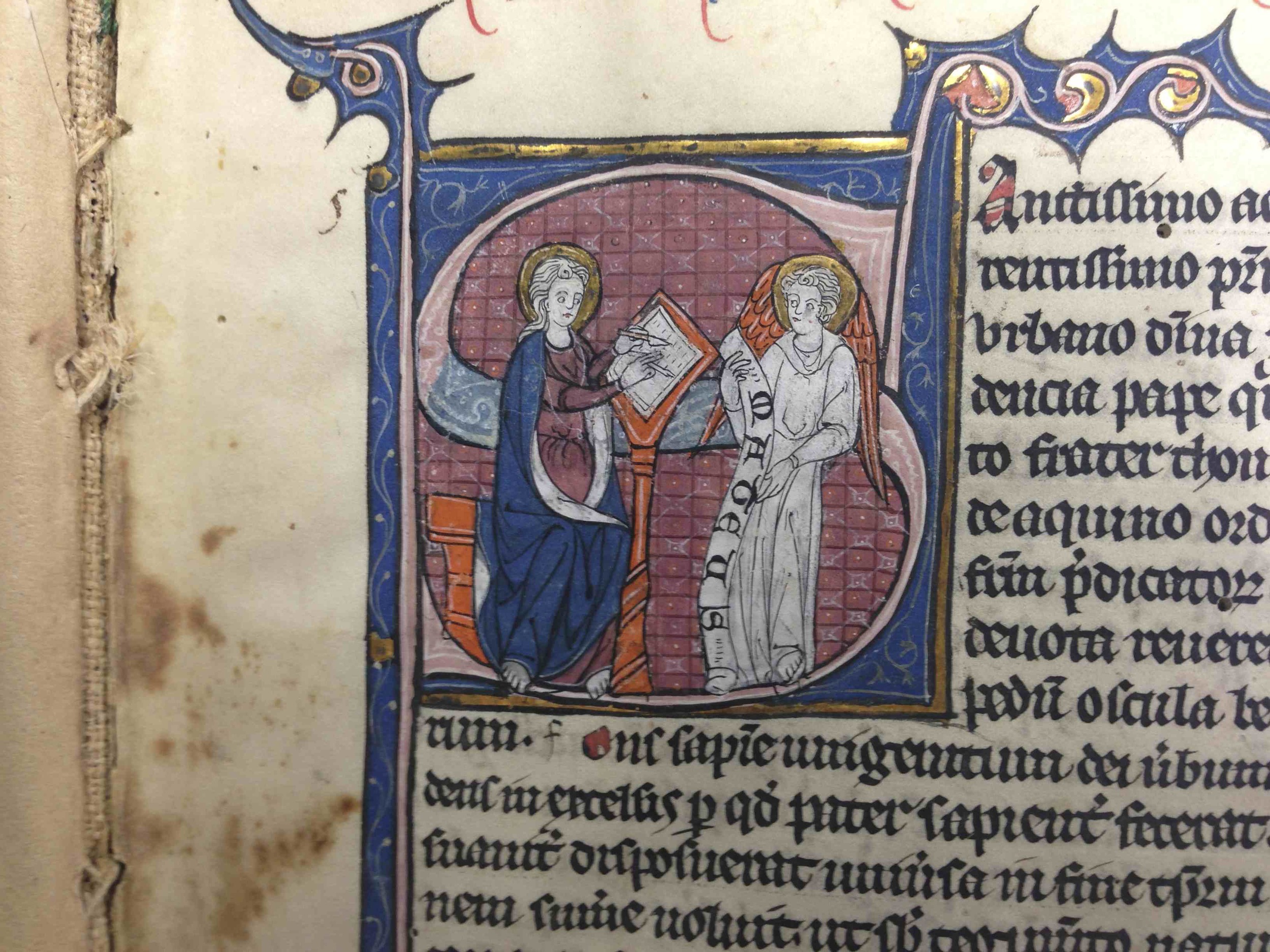
thomasinternational.org (a web site devoted to Aquinas)

It’s amazing what you’ll find when you hunt around websites that Ralph McInerny of Notre Dame has a role in. In looking through the website for the Jacques Maritain Center at Notre Dame, I discovered that there is an international web site on Thomas’s legal theory, which describes itself as follows:

Thomas International aims at reigniting the classical tradition of philosophy and theology – which is the cultural root of Western civilization – by promoting international scholarship focused especially (though not exclusively) on the thought of Thomas Aquinas. This commitment is not of merely historical interest, but is meant to promote engagement between classical thought and modern and contemporary thought, in all branches of human knowledge, in order to confront the perennial questions of the human heart and to seek solutions to the problems facing our society.

Thomas International is especially committed to promoting a new International University with the main campus in the United States, which will subsequently become the new center for its broad cultural enterprise.

Thomas International fulfills its mission through the joint activity of various Research Institutes, and through scientific collaboration with other universities and educational institutions.

There are also many links, especially to sites in Italy, that touch upon Aquinas.
Comment

Mark Johnson

Mark Johnson is an associate professor of Theology at Marquette University, and founded thomistica.net on Squarespace in November of 2004. He studied with James Weisheipl, Leonard Boyle, Walter Principe, and Lawrence Dewan, at the Pontifical Institute of Mediaeval Studies (Toronto, Canada).

Fabulous on-line list of medievalia

I just found a great on-line resource of medieval links (to journals, libraries, other websites, etc.). You’ll find it at:

http://www.ulb.ac.be/philo/urhm

which is run by the people at the Free University of Brussels (l’Université Libre de Bruxelles). It’s wonderful. The site also points to a consortium of other medievalist sites, and a portal for medievalists that is as thorough as I have yet seen.

Comment

Mark Johnson

Mark Johnson is an associate professor of Theology at Marquette University, and founded thomistica.net on Squarespace in November of 2004. He studied with James Weisheipl, Leonard Boyle, Walter Principe, and Lawrence Dewan, at the Pontifical Institute of Mediaeval Studies (Toronto, Canada).

Scotus Commission call for papers for 7th Centenary

This is a bit of a stretch for a Thomistic web site, but:

The Commissio internationalis scotistica is compiling a series of original scholarly articles on the Blessed John Duns Scotus and on the various aspects of the Scotism. The volume is intended to be an early contribution to the 7th centenary of Scotus’ death and also a homage to the memory of father César Saco, who unexpectedly died last February, after being a member of the Commissio scotistica for forty years.

Scholars who wish to participate, are kindly requested to send the proposed title of their article together with their address. On September 2005, we will give further details to those who have adhered to this initiative.

Contact address:

Martín Carbajo Núñez, ofm
Pontificia Università Antonianum
Via Merulana 124 b
00185 Roma (Italia)

E-mail: cnmartin@ofm.org / antonianumfacteol@ofm.org

Comment

Mark Johnson

Mark Johnson is an associate professor of Theology at Marquette University, and founded thomistica.net on Squarespace in November of 2004. He studied with James Weisheipl, Leonard Boyle, Walter Principe, and Lawrence Dewan, at the Pontifical Institute of Mediaeval Studies (Toronto, Canada).

Society for Medieval Logic and Metaphysics

I found this link a while back (as an offshoot from Gyula Klima’s fine personal web site), and simply forgot to post it:

The Society for Medieval Logic and Metaphysics (S.M.L.M.) is a network of scholars founded with the aim of fostering collaboration and research based on the recognition that:

  • recovering the profound metaphysical insights of medieval thinkers for our own philosophical thought is highly desirable, and, despite the vast conceptual changes in the intervening period, is still possible;
  • but this recovery is only possible if we carefully reflect on the logical framework in which those insights were articulated, given the paradigmatic differences between medieval and modern logical theories.

The Society’s web site is designed to serve the purpose of keeping each other up-to-date on our current projects, sharing recent results, discussing scholarly questions, and organizing meetings.

Comment

Mark Johnson

Mark Johnson is an associate professor of Theology at Marquette University, and founded thomistica.net on Squarespace in November of 2004. He studied with James Weisheipl, Leonard Boyle, Walter Principe, and Lawrence Dewan, at the Pontifical Institute of Mediaeval Studies (Toronto, Canada).

Medieval Tradition of Natural Law at Kalamazoo

Harvey Brown, in the Deptartment of Political Science at the University of Western Ontario, in London, Ontario (Canada) is calling for papers for the sessions devoted to the Medieval Tradition of Natural Law at the medievalists’ conference in Kalamazoo, Michigan for next spring (May 4-7, 2006). There will be two sessions:

  1. Natural Law and Virtue
  2. Natural Law as Ethics in Governance

Please send proposals to Harvey Brown by September 16, 2005 at: hbrown2@uwo.ca.

Comment

Mark Johnson

Mark Johnson is an associate professor of Theology at Marquette University, and founded thomistica.net on Squarespace in November of 2004. He studied with James Weisheipl, Leonard Boyle, Walter Principe, and Lawrence Dewan, at the Pontifical Institute of Mediaeval Studies (Toronto, Canada).

Proceedings from Dutch-Flemish SITA conference on Aquinas (from Sept. 2004)

The Dutch-Flemish section of the SITA (http://users.skynet.be/thomisme), presided over by Leo J. Elders svd, organized its first conference on September 25, 2004 at the former Abbey of Rolduc (the Netherlands). The topic of the conference was “The actuality of Saint Thomas Aquinas.”

The proceedings of this conference, together with other essays, are now published in the series ‘Doctor Humanitatis.’

This first publication contains 13 essays, written in Dutch, English and German. The president of the International SITA, Abelardo Lobato op, opens the volume with an article on themes of the ‘quaestiones quodlibetales’. The president of the Dutch-Flesmish section, Leo Elders svd, investigates the presence of Plato in the writings of Aquinas. Bonifacio Honings ocd (Rome) shows how the Catechism of the Catholic Church is deeply indebted to Aquinas moral theology. Romanus Cessario op writes about the influence of Aquinas on Mel Gibson’s ‘The Passion of the Christ’. The Dutch scholar Jozef Wissink, member of the ‘Thomas Instituut’ in Utrecht, articulates the highly interesting links between the mental state of dementia patients and Aquinas’ theory of knowledge, Victor Ravensloot argues for the validity of hylemorphism, David Berger talks about the actuality of the Tertia Pars of the Summa.

Next, the volume reprints an influential article by the late Dutch Dominican, Johannes van der Ploeg, who died in 2004, on the role of Scripture in Thomistic theology. The doctrine of God is the topic of the essay by Harm Goris, member of the well-known ‘Thomas Instituut’ in Utrecht. The Polish Thomist, Tadeusz Guz, compares the anthropology of Aquinas and Hegel. Jörgen Vijgen, Vice-President of the Dutch-Flemish section, investigates the role of philosophical reasoning in Aquinas’ articulation of the dogma of the resurrection of the body. The volume closes with a critical review of the recent French volume by the so-called ‘School of Toulouse’ on the actuality of Saint-Thomas.

De actualiteit van Sint-Thomas van Aquino, ed. J. Vijgen (Boekenplan, Hoofddorp, 2005), pp. 215 [ISBN 907179491-1] (Doctor Humanitatis I), can be ordered through the publisher’s website: http://www.boekenplan.nl.

Comment

Mark Johnson

Mark Johnson is an associate professor of Theology at Marquette University, and founded thomistica.net on Squarespace in November of 2004. He studied with James Weisheipl, Leonard Boyle, Walter Principe, and Lawrence Dewan, at the Pontifical Institute of Mediaeval Studies (Toronto, Canada).

The University of Toronto Colloquium in Mediaeval Philosophy 2005

The University of Toronto Colloquium in Mediaeval Philosophy for 2005 will take place from September 23-24, 2005, at the University of St Michael’s College. The colloquium is sponsored by the Department of Philosophy, Department of Classics, and Centre for Medieval Studies, University of Toronto; University of St. Michael’s College; Pontifical Institute of Mediaeval Studies. Its organizers are: Deborah Black, Peter King, Martin Pickave. All sessions will be held in Alumni Hall, Room 400 (St. Michael’s College, 121 St. Joseph Street). The sessions are free and open to the public.

Friday, 23 September:

4:30 - 6:30 opening remarks

SESSION I: Chair, Jennifer Ashworth (University of Waterloo)

  • Scott MacDonald (Cornell University): “Aquinas on Prudence: From Personal Virtue to Natural Law”
  • Thomas Williams (University of Southern Florida), commentary

6:30 reception

Saturday, 24 September:

10:00 - 12:00

SESSION II: Chair, Robert Pasnau (University of Colorado, Boulder)

  • Richard Cross (Oxford University): “Scotus on Substance and Identity”
  • Timothy Noone (Catholic University of America), commentary

lunch break

2:30 - 4:30

SESSION III: Chair, Jack Zupko (Emory University)

  • Claude Panaccio (Universite de Quebec a Montreal): “Ockham on Conceptual Similitudes”
  • Gyula Klima (Fordham University), commentary

7:00 Conference Dinner (reservation required)

If you plan to attend please let us know: medieval.philosophy@utoronto.ca. Accomodations: The Quality Hotel Midtown (to be rebranded as the Holiday Inn Midtown) in Toronto, located next to the St. George campus, is offering rooms at a reduced rate for the conference if you reserve before August 23rd: call (416)-968-0010, and use the Group ID #102835 or the Group name “Toronto Colloquium in Mediaeval Philosophy”.

Comment

Mark Johnson

Mark Johnson is an associate professor of Theology at Marquette University, and founded thomistica.net on Squarespace in November of 2004. He studied with James Weisheipl, Leonard Boyle, Walter Principe, and Lawrence Dewan, at the Pontifical Institute of Mediaeval Studies (Toronto, Canada).

A new blog about "Le manuscrit médiéval"

A sign that the end-times are upon us (New idea.): Jean Luc Deuffic, of pecia fame, now has a blog devoted to the medieval manuscript. Check it out here. Really, really neat. And packed with links to other resources in medieval textual production and paleography.

1 Comment

Mark Johnson

Mark Johnson is an associate professor of Theology at Marquette University, and founded thomistica.net on Squarespace in November of 2004. He studied with James Weisheipl, Leonard Boyle, Walter Principe, and Lawrence Dewan, at the Pontifical Institute of Mediaeval Studies (Toronto, Canada).

3rd annual Midwestern Conference in Medieval Philosophy (Marquette University)

The Third Annual Midwestern Conference in Medieval Philosophy will be held at the Marquette University in Milwaukee, Wisconsin, 16-17 September 2005. The conference is intended to provide a formal occasion and central location for philosophers and scholars of the Midwest region (and elsewhere!) to present and discuss their current work in medieval philosophy. Plans are for 9-10 sessions with 75 minutes allotted for presentation and discussion. If you wish to present, please send a title of the proposed paper to Richard Taylor at richard.taylor@marquette.edu. Conference sessions will take place in the Raynor Library Friday and Saturday 16-17 September, 2005.

Arrangements have been made for a block of 12 reserved rooms just a few blocks down the avenue from Marquette University at:

The Holiday Inn Milwaukee City Center
611 West Wisconsin Avenue
Milwaukee, WI 53203. Tel. 1-414-273-2950
Rate: $89/nt. single or double

Reservation deadline: August 15, 2005

Conference Website: http://homepage.mac.com/mistertea/Personal32.html.

Comment

Mark Johnson

Mark Johnson is an associate professor of Theology at Marquette University, and founded thomistica.net on Squarespace in November of 2004. He studied with James Weisheipl, Leonard Boyle, Walter Principe, and Lawrence Dewan, at the Pontifical Institute of Mediaeval Studies (Toronto, Canada).

Chronical for Higher Education job-listings in RSS

The people in the Careers Section of the Chronicle for Higher Education have made the contents of their job-listings available on-line, which you can access by clicking here. In addition, they’ve also made those listings available in an RSS newsfeed. Here are the addresses for the philosophy newsfeed, and the religion newsfeed:

You’ll be getting these items one week later, I believe, than those who subscribe to the on-line service or to the Chronicle itelf. But since the due-dates for applications are usually a month or two in the offing, you’re not suffering for it.

Comment

Mark Johnson

Mark Johnson is an associate professor of Theology at Marquette University, and founded thomistica.net on Squarespace in November of 2004. He studied with James Weisheipl, Leonard Boyle, Walter Principe, and Lawrence Dewan, at the Pontifical Institute of Mediaeval Studies (Toronto, Canada).

Colloquium on Aquinas and the theology of religions (Institut Saint-Thomas d’Aquin: Toulouse, France)

Saint Thomas d’Aquin et la théologie des religions

Colloque, les 13 et 14 mai 2005 à l’Institut catholique de Toulouse

Sous la présidence de Mgr Émile Marcus (archevêque de Toulouse)

Organisé par la Revue thomiste / Institut Saint-Thomas d’Aquin

La théologie des religions, c’est-à-dire l’intelligence dans la foi du rôle des religions non chrétiennes dans le dessein de Dieu, est reconnue comme un défi majeur pour la théologie chrétienne du xxi e siècle. Elle est rendue urgente par l’expérience désormais quotidienne que les chrétiens font de la pluralité des religions. Elle engage les thèmes les plus décisifs de la foi et de la théologie : le salut, l’unicité de la médiation du Christ, le rôle de l’ é glise… La tradition thomiste peut-elle apporter quelque lumière dans ce débat? Pour y répondre, l’Institut Saint-Thomas d’Aquin de Toulouse et la Revue thomiste organisent un colloque qui interrogera tout d’abord saint Thomas lui-même. Quels sont les grands principes de sa théologie susceptibles de fonder une théologie des religions ? Qu’en est-il, dans l’œuvre de saint Thomas, de la question plus précise du statut religieux des non-chrétiens, avant comme après la venue du Christ ?

A sa suite, la tradition thomiste, ancienne ou plus récente, n’a cessé d’actualiser cette réflexion. Aujourd’hui encore, à la lumière des principes de saint Thomas, ce colloque tentera de proposer quelques orientations pour une théologie, ouverte et critique, des religions non chrétiennes.

L’ensemble des conférences et débats se déroulera à l’Institut catholique de Toulouse (31 rue de la Fonderie, 31068 Toulouse).

Comment

Mark Johnson

Mark Johnson is an associate professor of Theology at Marquette University, and founded thomistica.net on Squarespace in November of 2004. He studied with James Weisheipl, Leonard Boyle, Walter Principe, and Lawrence Dewan, at the Pontifical Institute of Mediaeval Studies (Toronto, Canada).

Pontifical Academy of Saint Thomas Aquinas publishes 2003 conference proceedings

From the Secretary of the Pontifical Academy of Saint Thomas Aquinas:

The Pontifical Academy of Saint Thomas Aquinas is proud to announce the publication of the first and second volume of the Proceedings of the International Conference on “Christian Humanism in the Third Millennium: The Perspective of Thomas Aquinas”. The first volume is 1010 pages long and contains the Anthropological and Historical Sections. The second volume is 1011 pages long and contains the Christological, Metaphysical, Moral and Scientific Sections. Each volume costs USD 39 or Euro 29.65 - or the equivalent in the currency of your country - including postage but excluding bank charges. Methods of payment:

  1. (Cheapest way) By cheque made out to Pontificia Accademia di San Tommaso and sent by mail to the following address: Pontificia Accademia di San Tommaso, Casina Pio IV, V-00120 Vatican City.
  2. Bank transfer to: Account no. 1000 / 00009396; Owner: Pontificia Accademia di San Tommaso; Bank: San Paolo Imi; Agency: 06016; Address: Stazione Termini Binario 1, 00185 Roma, Italia; IBAN IT15 R010 2503 2511 0000 0009 396; BIC IBSPITTM

Payment can be made in dollars or in euros or in the equivalent amount in your country’s currency. After making the payment, please send me an email stating how many copies of the second volume you require and your full address. We will send out the books as soon as we have received notice of payment.

Volume III will be ready shortly. Please send an email to past@acdscience.va and you will be notified of its publication.

Of course, if you have someone in Italy who can make the payment for you or come directly to our Pontifical Academy in order to save on bank charges, we will then be more than happy to send you the books.

Comment

Mark Johnson

Mark Johnson is an associate professor of Theology at Marquette University, and founded thomistica.net on Squarespace in November of 2004. He studied with James Weisheipl, Leonard Boyle, Walter Principe, and Lawrence Dewan, at the Pontifical Institute of Mediaeval Studies (Toronto, Canada).