Why Postliberalism Failed
Reviewed by John Macias, St. Mary’s Seminary & University.
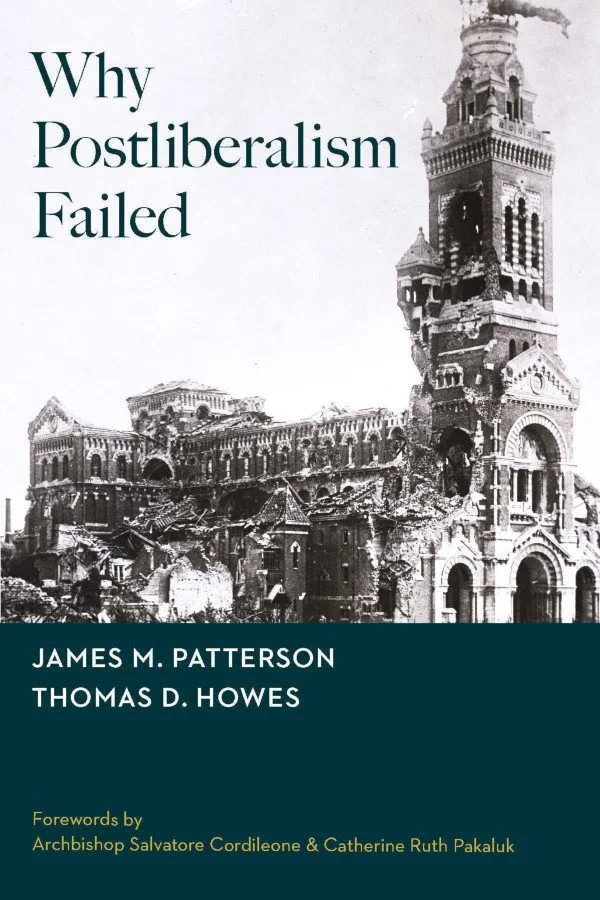
Why Postliberalism Failed. James M. Patterson and Thomas D. Howes. Acton Institute, 2026. 358 pp. ISBN-13: 979-8234071835.
James M. Patterson and Thomas D. Howes have contributed to what has now become a genre of political obituaries in their new book, Why Postliberalism Failed, published by the Acton Institute. They draw inspiration for its title from Patrick Deneen’s 2018 Why Liberalism Failed. Howes also published “Why Integralism Failed,” a review of Kevin Vallier’s All the Kingdoms of the World. Patterson and Howes offer a harrowing narrative. Indeed, if their account is accurate, postliberals want to recreate a Catholic state that strips away civil rights and imprisons heretics. Patterson and Howes’s story is certainly compelling, but ultimately it fails to show that it reflects postliberals today. The book will certainly convince those who are already opposed to postliberalism and Catholic integralism, but it will not do much to persuade postliberals and those inclined in their direction.
Why Postliberalism Failed is divided into three overall sections. First, it describes postliberalism and summarizes its key figures. The second unit offers a history of regimes Patterson and Howes consider postliberal or integralist as examples of postliberalism. The final section gives a philosophical critique of postliberalism, argues that it contradicts the Church’s teaching on religious liberty, and claims postliberals advance a deeply deficient economic theory.
In the first section, Patterson and Howes explain postliberalism’s various representatives, such as Deneen, Adrian Vermeule, Sorab Ahmari, and integralists like Thomas Pink, Alan Fimister, and Fr. Thomas Crean. Why Postliberalism Failed does not offer a strict definition of Postliberalism, but it identifies ideological, institutional, and political components. Postliberals reject individual liberty, economic opportunity, and democratic self-government (16). Postliberalism and integralism are, according to Patterson and Howes, interchangeable terms. Preferring the name "postliberalism” rather than “integralism” is a marketing choice on the part of postliberals. They draw on popes such as St. Gelasius I, Leo XIII, and Boniface VIII, as well as “reactionary” figures that include Joseph de Maistre, Louis de Bonald, and Louis Veuillot. Reactionary tendencies lead to the work of Carl Schmitt, a Nazi jurist and critic of liberalism.
Unit 2, although the longest of the three, is the easiest to summarize. It presents a set of historical accounts of regimes that Patterson and Howes identify as postliberal or integralist. They distinguish between postliberals and integralists who attempted to curry favor with dictatorial leaders but did not themselves attain power, and those integralists who in fact came to positions in government. Portugal, Brazil, Argentina, and Belgium are examples of the first, while Vichy France, Austria, Spain, Slovakia, and Croatia are examples of the second. The details of each example are incredibly complex and multifaceted, yet Patterson and Howes’s story is rather simple. Attempts to pursue integralist policies repeatedly failed to maintain power and ended in massive death and destruction.
In the last unit, Why Postliberalism Failed offers a final argument against postliberalism. Patterson and Howes accuse postliberals’ critiques of liberalism of relying on too broad a definition of liberalism, believing that an abstract concept like “liberalism” can have causal power in historical events, and ignoring liberalism’s successes. They argue that, to achieve any political gains, postliberals must water down their integralist aims, which means embracing the very liberalism they reject (247). The final two chapters attempt to show that postliberalism contradicts Dignitatis Humanae’s teaching on religious freedom and that it embraces anti-abundance economic policies. Patterson and Howes favor Martin Rhonheimer’s interpretation of Dignitatis Humanae over Thomas Pink’s policy change reading (272). They believe that Vatican II developed Church teaching through adopting a new political philosophy, which changed its understanding of Church and state relations. The work concludes with a summary of their economic view of limited government action and increased entrepreneurial opportunity.
The strongest aspects of Why Postliberalism Fails are its rhetorical narrative power and the problematic aspects of historical integralist figures and policies it displays. Patterson and Howes do in fact present a stark image. Their story of postliberalism, if accurate, should cause many to fear the current push for postliberal ideals. Patterson and Howes do point to real problems in previous attempts to pass integralist and postliberal laws, as well as the antisemitic and racist motivations of some of its proponents. I believe contemporary postliberals have the opportunity to identify the historical policies or methods they reject and show that their own principles do not require accepting these positions. Such a need is not unique to postliberals, since Aristotelians have attempted to separate Aristotle’s ethical and political arguments from his views on women, natural slavery, and laborers. We Americans face the challenge of acknowledging that some of our Founding Fathers, while eloquently defending freedom and liberty, owned slaves. Postliberals should either challenge Patterson and Howes’s history or demonstrate how their core views are not affected by these problems.
A fundamental weakness of the work is that it is essentially three books in one. Patterson and Howes try to combine a philosophical critique covering half a dozen or more figures, a history of regimes spanning some 200 years and 9 countries, and contribute to the highly contested question of the proper understanding of Dignitatis Humanae. Any one of these goals would require its own book. The upshot of trying to cover all these issues in one book is a somewhat superficial description of dense philosophical and theological positions. The ambitious goals of Why Postliberalism Failed lead to scholarly and philosophical shortcomings. Scholarly problems concern the sources Patterson and Howes use for the philosophical and theological claims of postliberals. They quote posts on X/Twitter as prominently as published books or articles, and at least twice they reference deleted posts (31, 32). In the footnotes to these posts, they cite screenshots that they have saved. The use of social media is not in itself a major problem, but Patterson and Howes place a great deal of weight on individual posts. X/Twitter, however, is not a place for thoughtful and nuanced arguments. Patterson and Howes’s use of X/Twitter as a source draws attention to individual statements rather than arguments. This emphasis on conclusions rather than principles is a frequent characteristic of Patterson and Howes’s book. To be sure, Patterson and Howes do clearly draw on published works of postliberals, like Deneen’s Regime Change and Integralism by Fimister and Crean. The work, however, does not focus on expounding the thought of any single figure, nor does it give much of any consideration to the work of Aristotle or St. Thomas Aquinas, whom postliberals often take as their principal inspirations.
The reason why these scholarly shortcomings are important is because Patterson and Howes want to connect Patrick Deneen, Adrian Vermeule, Gladden Pappin, Chad Pecknold, Alan Fimister, Fr. Thomas Crean, Pater Edmund Waldstein, and Sorab Ahmari, and they seek to show they are all committed to one and the same political agenda. This agenda is expressed in Fimister and Crean’s Integralism (31). Trying to place such a wide array of figures under a single ideology requires a significant amount of evidence, especially when the claim is that figures like Deneen, Vermuele, and Amari agree with the substance of Integralism. In fact, Deneen himself has explicitly stated that he is not integralist. Despite Patterson and Howes’s insistence on using X/Twitter, they fail to consider a post from 2024 wherein Deneen states, “while I am friendly to challenges against the liberal view of ‘strict separation,’ there is nothing specifically Catholic in my stance.” Patterson and Howes might argue that Deneen only says such things because he realizes how unpopular the idea of a Catholic state would be today, but this response seems to fall victim to the very conspiratorial narrative for which they condemn historical integralists and postliberals.
As noted, a major substantive problem with Why Postliberalism Failed is its failure to present and engage with the principles of postliberals. Doing so would, I believe, reveal that integralism is a particular kind of postliberalism rather than simply another name. It is odd that Patterson and Howes begin their account of contemporary postliberalism with Patrick Deneen rather than a figure like Alasdair MacIntyre. Many see him today as the standard-bearer for those who reject liberal individualism in favor of an Aristotelian politics of the common good. In fact, Deneen’s appeal for strengthening local communities in Why Liberalism Failed has clear similarities to MacIntyre’s small-scale deliberative politics. Furthermore, Patterson and Howes do not consider the Aristotelian or Thomistic sources for postliberalism and integralism. Kevin Vallier, in his All the Kingdoms of the World, dedicates its entire third chapter to discussing St. Thomas’s understanding of natural law. Vallier argues that St. Thomas’s understanding of law favors the integralist view that government should direct citizens to their supernatural good. Vallier, of course, then argues against essentially the Thomistic view of political communities and law. I argued that Vallier presumed liberalism in his criticism of integralism, but he spends a great deal of time to lay out the reasons for integralist conclusions. For a critique to be effective, one’s interlocutors should be able to see themselves in the arguments one gives. Postliberals will likely not recognize themselves in Patterson and Howes’s work.
If Patterson and Howes did consider the principles behind postliberals and integralists, they would have found an Aristotelian and Thomistic politics of the common good. The political community crafts law for the sake of leading its citizens to human virtue and flourishing in accordance with natural law. Citizens achieve this end through pursuing their common good. Law, on this view, educates individuals in the demands of virtue and the good of society. Authority, then, is a necessary part of coordinating individuals and institutions for the sake of a shared end. A government is just then when it rules for the sake of the common good and virtue, and when all laws respect the natural law. Regimes become unjust if they rule only for the sake of private goods or if a given law violates the natural law. In the United States, laws allowing marriage between same-sex couples or permitting abortion are unjust acts because they clearly contradict the natural law precepts regarding human life and procreation. With these principles in mind, we can see that, contrary to what Patterson and Howes claim (16), postliberals and integralists have no reason to oppose individual liberty or democratic self-government. In the first volume of the two-volume collection Integralism and the Common Good, Zachary Thomas argues that, so long as we stay within the natural law and understand the role of God, democracy could even be the best form of government in contemporary circumstances (“Logos and Leviathan: Leonine Perspectives on Democracy,” 251). In that very same volume, Daniel Lendman explains that, given the Thomistic view of natural law as our participation in God’s eternal law, then it naturally follows that all authority, in whatever form it takes, derives from God (“A Note on the Legitimacy of Governments,” 213-16). Lendman cites Pope St. John XXIII, hardly anyone’s image of a postliberal or integralist, who clearly states in Pacem in Terris, “every civilized community must have a ruling authority, and this authority, no less than society itself, has its source in nature, and consequently has God for its author” (§46). Integralists, by noting that God is the source of all authority, do not necessarily mean a divine right of kings. Rather, they simply observe that human law follows from natural law, and the natural law is our participation in the eternal law. All law, whether this be from democrats or monarchists, must submit to God.
A better understanding of principles would show that postliberalism certainly is not interchangeable with Fimister and Crean’s Integralism, and in fact not even self-described integralists are interchangeable with Fimister and Crean. Patterson and Howes make the mistake of believing that a regime is integralist only if takes the strongest forms. Vallier makes this same mistake in his book, but at the time his work was published few other explanations of integralism existed. By now, however, several other understandings of Catholic integralism exist. Ed Feser, on his blog, introduced various versions of integralism, and he presented this account again when reviewing Vallier’s book for The Josias. I have presented a more detailed account of the different forms that an integralist state could take. Similar to Feser, I argue that an integralist state could take strong, moderate, and weak forms. Fimister and Crean defend a strong version of integralism, but I argue an integralist state could take a weak form that resemble more a general confessional state. A weak integralist state would enforce natural law, establish basic civil rights for all, and direct all citizens to virtue. Such a state could pass laws punishing blasphemy and explicitly affirm the existence of God and our obligations towards him, but these policies follow from the natural law and not special revelation. This state could be a largely democratic government, or it could have monarchical elements. To be sure, many cultural and demographic factors would determine the form of integralism, but the point is that even self-avowed integralists need not demand a strong integralist state as found in Fimister and Crean.
Patterson and Howes may in fact be right that contemporary postliberals are involved in a coordinated effort to turn the United States of America into a modern-day Christendom. Readers will certainly receive this impression from Why Postliberalism Failed. Unfortunately, in their ambition to reach such sweeping conclusions, their evidence falls short. They fail to show that all postliberals share identical views, and they do not demonstrate how postliberal principles necessarily lead to one and the same set of political conclusions. At best, they do show that all postliberals agree in rejecting liberalism. This failure to explain the core beliefs of postliberalism is ironic, since Patterson and Howes criticize postliberals for having too broad an understanding of liberalism. To show that postliberalism really has failed, we need three books rather than one. With Patterson and Howes joining Vallier with their criticisms of postliberalism, we will see whether postliberals do in fact fail. If it demonstrates a recurrent appeal, perhaps postliberalism possesses enduring truths. It may be the case that, to paraphrase Étienne Gilson, postliberalism always buries its undertakers.