Anatomy of Transcendence: Mental Excess and Rapture in the Thought and Life of Saint Thomas Aquinas
Reviewed by Joey Belleza, Mount St. Mary’s Seminary & School of Theology (Athenaeum of Ohio)
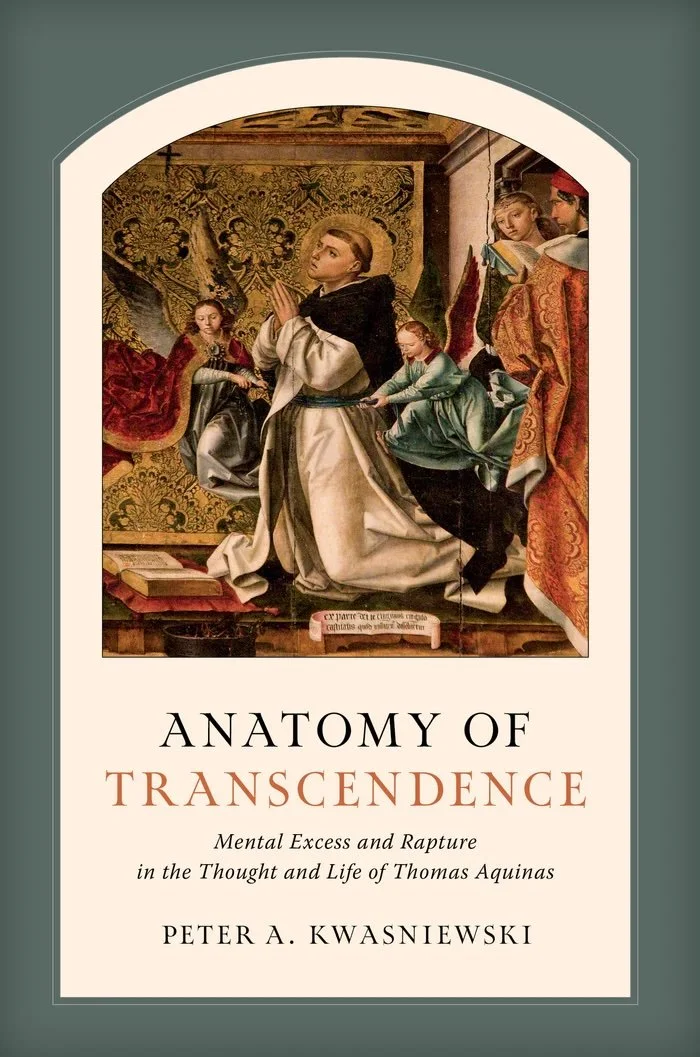
Peter A. Kwasniewski, Anatomy of Transcendence: Mental Excess and Rapture in the Thought and Life of Saint Thomas Aquinas. Emmaus Academic, 2025. 320 pp. ISBN (Hardcover): 9781645854289.
The topic of love and its effects in the works of Thomas Aquinas has occupied Peter Kwasniewski for the better part of three decades. An edited version of his 2002 doctoral dissertation, “The Ecstasy of Love in Thomas Aquinas,” was published as the 2021 monograph The Ecstasy of Love in the Thought of Thomas Aquinas. Since earning his doctorate, he has continued to write on ecstasy in Aquinas, publishing no less than seven academic articles on the topic. Four of these essays form the basis of four chapters in the present work presently under consideration, while two chapters represent his more recent substantial contributions to this area of Thomistic studies.
In these six densely packed chapters, then, Kwasniewski continues to deepen his own appreciation for the ecstatic element in the teaching of Saint Thomas. A rigorous lexical study of the notion of ecstasy in Chapters 1 and 2 (“Modalities of Excess” and “Excessus mentis in Scripture”) covering its diverse modalities and usage in both the tradition and in the Bible, sets the stage for the more speculative aspects of Thomas’s thought on ecstasy. Chapters 4 and 5 (“Healthy Madness, Sober Drunkenness,” and “Intellectualism and the Beatific Vision”) demonstrate how Aquinas’s construal of the mystical life is not marked by a total relinquishing of reason nor of intellect, while Chapter 6 (“Iconographic Incompleteness and the Golden Straw”) is a short yet rich exposition of the ecstatic episodes which marked the end of Thomas’s earthly life. Since much of the discussion in these chapters do not, on the whole, represent Kwasniewski’s more recent reflections on ecstasy in Aquinas, we will abstain from considering them at length. However, a general comment is worth making: Kwasniewski’s expansive attention to the entire Thomistic corpus and Thomas’s own historical development is one of the book’s principal strengths.
Chapter 3 (“Raptus ad divina: The Experience of Saint Paul”), however, is perhaps the signature contribution of this book. For many medieval masters, the rapture of Paul to the third heaven in 2 Corinthians functioned as the archetype of mystical union, and in this 86-page chapter (the longest of the six and constituting nearly a third of the main text), the author meticulously presents Thomas’s reading of this scriptural episode as treated in three principal loci: the Commentary on 2 Corinthians, De Veritate 13, and Summa Theologiae II-II. Other extended remarks on raptus as found in the Commentary on Sentences IV—already treated by Kwasniewski in a previously published article—is not presented as a fourth locus, but remains a helpful and consistent point of reference throughout the chapter. Significantly, the author finds that Thomas’s treatment of Paul’s rapture (and rapture in general) is remarkably consistent across his works. This is wonderfully summarized by the chart on page 184, wherein raptus is considered under the twofold manner of cause and effect, and cause and effect each considered with respect to the cognitive and appetitive orders.
If there be any principal reason for improvement, this book (as an Emmaus Academic monograph geared toward specialists) might have been better adequated to its audience. A bit too often it smacks of the tedium expected of an unrevised dissertation rather than a well-streamlined presentation for a cultivated audience. The use of long block quotes in English with the original Latin reproduced in the footnotes contributes to the perhaps excessive length of especially the third chapter; paraphrased commentary or explanation in the main text while retaining the quoted Latin text in the footnotes, or helpful charts like the one described above, not only would have served the overall presentation better, but would have also further showcased the author’s own interpretative and speculative acumen. An over-reliance on simply reproducing the verba Thomae might risk what Fr. Cajetan Cuddy has labeled “theologianology,” or simply (re)presenting the doctrines of theologians for its own sake, rather than as guides for higher speculation. Kwasniewski ultimately escapes such a critique, however, because of how clearly he imparts a tone of prayer and piety, especially as the book concludes.
A set of minor yet related critiques: this book showed no sign of engagement with two important contributions to Thomistic mystical theology: Bernhard Blankenhorn’s The Mystery of Union with God (CUA Press, 2015) and Daniel Gordon’s The Passion of Love in the ‘Summa Theologiae’ of Thomas Aquinas (CUA Press, 2023). The relative brevity of Chapter 5 on “intellectualism” in the beatific vision would have been well-bolstered by Blankenhorn’s work on the cognitive aspects of Thomistic mysticism, while the also-brief Chapter 4 would have better specified the nature of “sober drunkenness” by reading ecstasy, as Gordon did, in light of the other effects of love (union, mutual indwelling, and zeal; cf. ST I-II, q. 28). The engagement with secondary literature seems limited to the status quo of the time when the chapters originally appeared as articles; in the case of “new” chapters like Chapter 3, the annotations overwhelmingly refer either to Thomas’s own texts, or to Kwasniewski’s past works. However, contemporary work on this question and related aspects of Thomas’s mysticism are not reducible to either Blankenhorn, Gordon, or Kwasniewski. Lastly, since Paul’s rapture was a locus classicus for medieval mystical theology, perhaps a more focused comparison with other scholastic treatments of the same scriptural text would have served Chapter 3 better, in concert with more paraphrased presentations of Thomas’s position.
Nevertheless, Anatomy of Transcendence is an outstanding contribution to Thomistic studies, and an excellent resource for scholars attempting to navigate the rich yet massively underappreciated affective aspects of Aquinas’s thought. Its breadth of scope across the Thomistic corpus, its close attention to the texts studied, and its deep appreciation of Thomas’s biblical exegesis are worthy of emulation. Accordingly, this reviewer offers a wholehearted recommendation, hopeful that it will spur further engagement with Saint Thomas’s mystical theology.