Reviewed by David Francis Sherwood, Ave Maria University
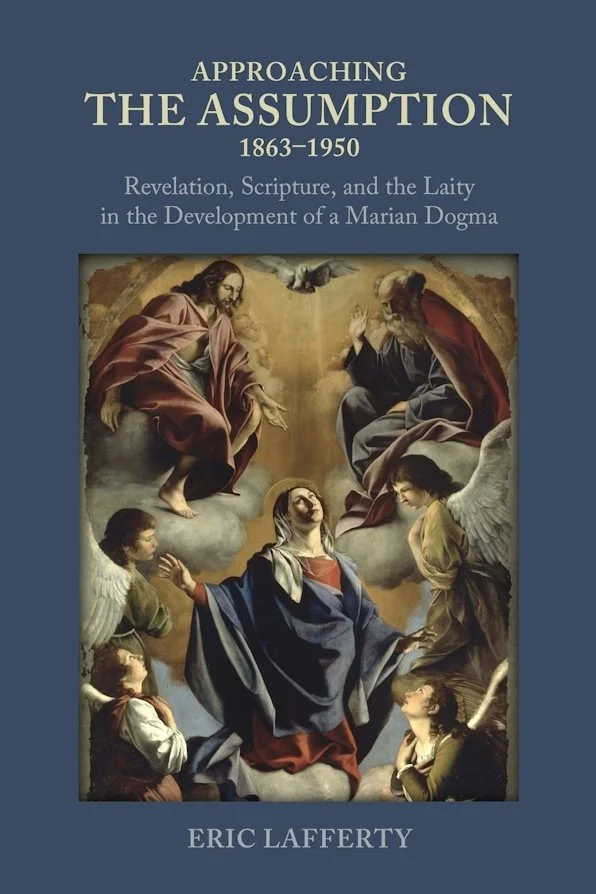
Eric Lafferty, Approaching the Assumption, 1863–1950: Revelation, Scripture, and the Laity in the Development of a Marian Dogma. Catholic University of America Press, 2026. xi + 223 pp. ISBN (Hardcover): 9780813239446. ISBN (eBook): 9780813239453.
Eric Lafferty has performed a great service to Catholic Mariology, having written what is likely the first monograph dedicated to the history of the movement advocating for the definition of the Assumption of the Blessed Virgin Mary as a dogma of the Catholic faith. Moreover, his book includes a rare investigation of the theological continuity between the Assumptionist Movement and the documents of the Second Vatican Council. Given that the Assumption is the last clearly ex cathedra papal definition of dogma, it is surprising that the movement which led to its definition has received so little historical investigation.
The Assumptionist Movement is defined as the period from Queen Isabel II of Spain’s 1863 petition to the Holy See requesting that the Assumption be defined, which coincided with the publication of a seminal study on the topic by Remigio Buscelli, to the actual definition in Munificentissimus Deus by Pope Venerable Pius XII on November 1, 1950 (41–43, 46). Lafferty’s reasoning about this is both straightforward and limiting. It is straightforward because 1863–1950 saw a nearly continuous fervor on the part of the faithful—laity and clergy alike—for a new dogmatic definition regarding the end of the Blessed Virgin Mary’s earthly life. This eighty-seven-year timespan, however, is limiting since Queen Isabel’s petition was not the first request to Rome for a definition of this dogma. In 1763, Cesario Maria Shguanin had petitioned Pope Clement XIII for a definition, and in 1849 two bishops (Archbishop Engelbert Sterckx of Mechelen and Bishop Jorge Sànchez of Osma) had requested that the Assumption be defined alongside the Immaculate Conception in their responses to Pope Pius IX’s Ubi primum, which had been written to consult the episcopacy about the potential definition of the Immaculate Conception (43).
The reason for limiting the Assumptionist Movement’s beginning to 1863 is that these requests were isolated and unconnected to any later activity (43n8). In the eyes of the Church’s two millennia lifetime, the fourteen years from the two episcopal requests during the consideration of the definition of the Immaculate Conception to 1863 may not be too discontinuous. This seems particularly likely insofar as the Assumptionist Movement depends upon the historical fact of the Immaculate Conception being defined by papal decree (consider 36–37). Yet Lafferty chooses to define the Assumptionist Movement not only as a time period, but also as a certain frequency in formal requests to Rome for a definition, as a series of public outreach campaigns and movements in public devotion to Mary as assumed, and even as a high degree of theological focus on the topic (47–72). These facts certainly highlight the importance of the Movement post-1863. Yet the very fact that some bishops connected the doctrine of the Assumption with that of the Immaculate Conception prior to the latter’s definition, a mere fourteen years prior to Lafferty’s 1863 start date, points to a potential historical connection between the movements for these two doctrines. These doctrines are also connected later in the monograph by various theologians in their systematic and dogmatic considerations (e.g., 56–57, 67, 80–81, 87, 89, 91–95, 97–98, 116, 127), making this historical consideration even more interesting.
Overall, Lafferty’s book is divided into six chapters, beginning with a chapter considering prior Marian dogmas—Mary as Mother of God, Ever-Virgin, and Immaculately Conceived—as prerequisites to understanding the definition of the Assumption and the debates that had surrounded it during this Movement (13–39). It is in chapter two (41–72) where Lafferty discusses the time period of this movement, including how theological efforts for a definition began in the wake of the foreshortened First Vatican Council (43–51); how extremely large petitions—with the largest single petition including over two million signatures—began to be sent to Rome requesting a definition (50–57, 59–60); how the devotion of the laity and of the clerical orders began to intensify both in general and specifically regarding Mary’s Assumption (51–60); and how large-scale theological discussions about the Assumption and efforts in favor of the definition intensified in the 1940s (60–68). Indeed, Lafferty defines 1946–1950 as the height of the Assumptionist Movement (73), focusing the middle of his book on discussing the arguments about the definability of this dogma in chapter three (73–100) and how it relates to Scripture and Tradition from this more limited time period in chapter four (101–134).
Chapter three gives a very useful overview of different theories of development, depending upon whether a given theologian thought that the Assumption was formally implicit to Revelation, that it was virtually revealed, or that its revealed status was only apparent by a convergence of probabilities à la Saint John Henry Newman’s theory on development (74–75). While Lafferty does not attempt to discuss all of the permutations of these different theories and the controversies surrounding them, even admitting that there were misunderstandings about some of these terms during debates on the Assumption (131–33), his easy presentation and ample examples of these three positions regarding development are very welcome. For the readers of Thomistica, this chapter is particularly interesting, beyond the general dogmatic interest of Lafferty’s book. Here, Lafferty discusses the positions of four theologians concerning the definability of the Assumption, beginning with the position of Father Réginald Garrigou-Lagrange, OP (84–87). Garrigou-Lagrange’s position is then compared and contrasted with the positions of two of the most important Franciscan Mariology specialists of the twentieth century, Father Juniper Carol, who founded the Mariological Society of America (87–91), and Father Carlo Balić, who founded the International Pontifical Academy of Mary (91–95). Moreover, these positions are also contrasted with that of Father Gérard Philips, who (with Balić) went on to play a very important role at the Second Vatican Council during its considerations of what became Lumen Gentium VIII (95–98).
Lafferty points to a lesser-known article of Garrigou-Lagrange’s from Divus Thomas 50 (1947), “La définibilité de l’Assomption.” For Garrigou-Lagrange, dogmas can only be defined if they are formally revealed—explicitly or implicitly. Moreover, implicitly revealed truths are implicit either because they are contained in the very words revealed or are a part of some whole which is itself a revealed truth (84–85). By way of contrast, Garrigou-Lagrange understood virtual revelation to be the domain of the human discipline of theology, where a theological conclusion is deduced from a premise that is revealed and another premise that is not included in Revelation (85). Since he thought that the Assumption could be proven from two formally revealed truths, or rather from two implicit parts of these formally revealed truths, Garrigou-Lagrange understood the Assumption to be definable as a dogma of the Catholic faith. Specifically, he argued that it is a formally revealed truth that Christ had a perfect victory over the devil, which implicitly includes His perfect victory over sin and its effects (in this case death), and that Mary was most closely associated with her Son in this perfect victory as His mother and as New Eve, which implicitly includes her association in overcoming death. Thus, Mary’s special association with her Son’s perfect victory over death requires her not to be overcome or conquered by the bonds of death. As such, she must participate in the new life of the resurrection prior to the general resurrection (87).
Lafferty points out that Garrigou-Lagrange and Carol were in close agreement on this question, though Lafferty credits Carol with putting more emphasis on the living Magisterium’s consensus being valid grounds for defining dogma. Yet Carol’s argument for the Assumption being formally implicit to Revelation depends explicitly upon Mary being Co-Redemptrix and for her co-redemption being itself formally revealed (90–91). Balić, on the other hand, thought that the Assumption was too obscurely included within Revelation for it to be found in two revealed premises, even implicitly (93–94). However, he maintained that dogmas could be defined as long as they could be syllogistically proven from one revealed premise, namely as long as they were virtually revealed (94–95). Lafferty’s citations particularly credit this view to Scholastic traditions stemming from Blessed John Duns Scotus and Francisco Suárez (94n106).
Less scholastically, Philips’s position emphasized the importance of history more than Garrigou-Lagrange, Carol, and Balić and was more hesitant about the capabilities of syllogistic reasoning in discerning dogma (96). Instead, dogmas develop by a convergence of theological reasoning proceeding from Marian co-redemption and exemption from sin (97–98). Yet Philips, unlike these more Scholastic authors, did not pretend that true certainty would be reached about the Assumption’s place in Revelation by this mode of argument and preferred to see a potential definition of the Assumption as a lived outcome of the Church’s faith (97).
In chapter four, Lafferty’s discussion of different exegetical positions on the Assumption’s relationship to Scripture is also useful as a survey of Catholic views on how dogmas are to be found in Scripture and in Tradition. The theologians and exegetes who are discussed here, however, are more varied and less well-known than those in chapter three. Lafferty offers evidence of a near consensus in this dogma’s relationship to Scripture. Specifically, Catholic biblical scholars approached a consensus that the Assumption is really connected to Scripture, but only when Scripture is interpreted in light of Sacred Tradition, where Scripture and Tradition must be received as one whole to adequately discern the revealed basis of the Assumption (133).
Chapter five discusses the theology of lay participation in the Church, given how positively the lay faithful cooperated with the teaching hierarchy of the Church in this Movement (135–164). Lafferty particularly discusses different understandings of a passive “learning church” and an active “teaching church” in perceiving and developing Catholic dogma, showing how common and inadequate this distinction was.
After having discussed the Assumptionist Movement itself, Lafferty discusses the Second Vatican Council’s continuity with the Movement in chapter six. Particularly, Lafferty focuses on how theologians saw the need for Sacred Tradition to inform the Church’s reading of Sacred Scripture and on the laity’s active, though specific, role in the Church (165–193). Indeed, Lafferty sees the Assumptionist Movement, with its theological debates on the foundations of the dogma of the Assumption and its degree of lay involvement, as useful events in pre-conciliar history to demonstrate how the Second Vatican Council is in clear continuity with the pre-conciliar Church (186–192). It should be noted, however, that Lafferty’s discussion about continuity in the Church could be clearer. Lafferty expressly relies upon the literary theory and methodology of Hans Robert Jauss, which emphasizes the importance of an audience’s active role in determining the meaning and value of a written work. Lafferty extends Jauss’s understanding of an audience’s role to the faithful’s active role in receiving Revelation. However, Lafferty also relies upon the concept of a “horizon of expectation” when discussing continuity (9–10, 186–92). To this reader, this language is inadequately explained, particularly regarding what it adds to the general notions of continuity and discontinuity in perceiving truth over time. As such, readers who are not familiar with Jauss and similar authors may struggle to perceive the value of this language of “horizon of expectation.”
Lafferty also concludes his monograph with helpful avenues for future research that become evident by having a fuller study on the Assumptionist Movement. Three such avenues are listed in the book’s conclusion: first, the Assumptionist Movement itself, in all of its activities and theological works; second, the reception of the works of Newman within this Movement, particularly regarding the laity, development of doctrine, and the illative sense; and, third, the relationship between the Assumptionist Movement and the Second Vatican Council, especially insofar as it parallels the relationship between the movement to define the Immaculate Conception and the First Vatican Council (199).
Lafferty’s monograph is not a speculative work, though chapters three and four on the development of doctrine and biblical exegesis discuss different positions within speculative theology. Rather, his book is a work of historical theology, relaying a historical movement ordered to a dogmatic definition. This is the exact value of Lafferty’s Approaching the Assumption. There has been no accessible English-language monograph that discusses the history of the development of the dogma of the Assumption immediately prior to Munificentissimus Deus, making this book a key source for discussing the development of the dogma of the Assumption, the development of Marian dogmas in general, the Mariological movement itself, and the Church’s relationship to the popular Marian devotions of its members. In this way, Approaching the Assumption is necessary reading for specialists in Mariology and also important reading for specialists on the development of Catholic dogma. Moreover, since Lafferty’s work is historical and does not depend upon more abstract theological considerations, it is accessible to a broader theological and historical audience, particularly for advanced undergraduate courses and graduate courses that discuss these topics.