Excerpts from Garrigou-Lagrange's commentary on De Eucharistia

This in, from Peter Kwasniewski, after the conference on Aquinas and the Sacraments at Ave Maria University in Florida in early February:

The clearest and most accessible treatment of Eucharistic topics I have yet found is contained in one of the volumes of the running commentary on the Summa theologiae composed by Fr. Garrigou-Lagrange for his students at the Angelicum (including Karol Wojtyla — I wonder if we can ascertain whether these manuals were among the books Wojtyla studied during his student days).  The document contains a selection of texts on, among other things, the prephilosophical or “common sense” notion of substance, the relationship of a subject to its accidents, the analysis of quantity in its various aspects (part outside of part; location and position).  There are also some texts on other sacraments and on the causality of the sacraments.

Kwasniewski provided two documents, the first covering Garrigou-Langrange’s commentary on the Tertia pars, qq. 73-82 (in Word or PDF format) and another with comments of Garrigou-Langrange on the Eucharist (again, in Word or PDF format).

Get your Quaracchi editions of Franciscan writers

At a conference at Ave Maria University in Florida earlier this month Bruce Marshall informed me that the famous Quaracchi editions of Franciscan authors can be purchased on-line, and for a reasonable price. This would include the works of St. Bonaventure, the Summa fratris Alexandri, the Vatican edition of the works of Scotus, and other franciscana.

Comment

Mark Johnson

Mark Johnson is an associate professor of Theology at Marquette University, and founded thomistica.net on Squarespace in November of 2004. He studied with James Weisheipl, Leonard Boyle, Walter Principe, and Lawrence Dewan, at the Pontifical Institute of Mediaeval Studies (Toronto, Canada).

The status quaestionis of Gratian Studies

Some recent research into the anti-mendicant controversies reminded me just how much Thomas knew about and employed canon law, all throughout his career. I have been reading Anders Winroth's important book, The Making of Gratian's Decretum (Cambridge: Cambridge University Press, 2000), and just found out that the author has a home page for Gratian studies. One of the many gems in the site is a lecture that Winroth gave at the Twelfth International Congress of Medieval Canon Law in 2004, entitled "Recent work on the making of Gratian's Decretum." To read the lecture (in PDF format) is to get a refresher course in Gratian and his work. I believe that I have mentioned before that the entire Decretum is on-line: a crucial resource.

Comment

Mark Johnson

Mark Johnson is an associate professor of Theology at Marquette University, and founded thomistica.net on Squarespace in November of 2004. He studied with James Weisheipl, Leonard Boyle, Walter Principe, and Lawrence Dewan, at the Pontifical Institute of Mediaeval Studies (Toronto, Canada).

On Remigius of Florence

RemigiusGavri.jpgThe Academic Press of the University of Fribourg (Switzerland) has just published this exciting work by Anto Gavric, a Dominican from Croatia. The author is also preparing the critical edition of Remigius’ De modis rerum which will appear in the prestigious series Corpus Christianorum Continuatio Mediaevalis. On his website you can find more on the author. Most exciting from an international perspective is the fact that he hosts this website focusing on Thomas Aquinas in Croatia.

Here is the text from the website of the editor in Fribourg:

Redécouvrant l’histoire du thomisme, le XXe siècle est marqué entre autres par un effort considérable de situer l’oeuvre et la doctrine de Thomas d’Aquin dans leur contexte historique propre, notamment par des études portant sur les premiers disciples de Thomas d’Aquin. Rémi de Florence est un témoin important pour notre connaissance de la transmission de la doctrine de Thomas d’Aquin et de son enseignement dans les studia dominicains en Italie, notamment à Florence. Notre travail met en évidence certains aspects de la doctrine thomasienne qui émergent du traité De modis rerum, considéré comme un traité de métaphysique. L’apport de Rémi de Florence devient incontournable pour la terminologie et l’histoire de la doctrine des transcendantaux. Le De modis rerum doit être sans conteste considéré comme le premier traité systématique sur les transcendantaux ou au moins être placé parmi les premiers. Il intègre dans ses réflexions philosophiques, logico-grammaticales, théologiques, de façon particulièrement remarquable, des recherches portant sur les multiples acceptions, divisions et définitions de termes. Le De modis rerum montre aussi que la question de Dieu a passionné les débats philosophiques médiévaux. En outre, on peut observer un troisième aspect de la pensée de Rémi, lorsqu’il évoque l’esse morale ou plus encore l’esse civile. Cet aspect s’avère d’une grande importance, car la philosophie politique apparaît comme une préoccupation très significative de la pensée du dominicain florentin: elle montre son intérêt pour l’actualité ainsi que son engagement actif dans la vie publique de son temps. Ces divers critères permettent de cerner la diversité de la pensée de Rémi de Florence ainsi que la spécificité de la philosophie médiévale.

354 pages, broché,
Fr. 64.- / EUR 39.50
ISBN 978-2-8271-1016-2

Comment

Jörgen Vijgen

DR. JÖRGEN VIJGEN holds academic appointments in Medieval and Thomistic Philosophy at several institutions in the Netherlands. His dissertation, “The status of Eucharistic accidents ‘sine subiecto’: An Historical Trajectory up to Thomas Aquinas and selected reactions,” was written under the direction of Fr. Walter Senner, O.P. at the Pontifical University of St. Thomas Aquinas (Angelicum) in Rome, Italy and published in 2013 by Akademie Verlag (now De Gruyter) in Berlin, Germany.

Conference on metaphysics of Aquinas in Rome

logoupra.gifThis is just in from Prof. Jésus Villagrasa L.C. of the Ateneo Pontificio Regina Apostolorum in Rome. They’re co-hosting a one-day conference on March 20, 2007 entitled “Creazione e actus essendi. Originalità e interpretazioni della metafisica di Tommaso d’Aquino”. Here is the program. If I could make it, I would be particularly looking forward to the papers on the “Patristic sources of the metaphysics of Aquinas” and “The ontological difference in 20th century Thomism”!

In addition the “Progetto Culturale Cornelio Fabro”, in charge of the edition of the collected works of the Italian Thomist Cornelio Fabro (see our Newsletter of March 2005), will present the edition of Fabro’s “Breve introduzione al tomismo”.


Comment

Jörgen Vijgen

DR. JÖRGEN VIJGEN holds academic appointments in Medieval and Thomistic Philosophy at several institutions in the Netherlands. His dissertation, “The status of Eucharistic accidents ‘sine subiecto’: An Historical Trajectory up to Thomas Aquinas and selected reactions,” was written under the direction of Fr. Walter Senner, O.P. at the Pontifical University of St. Thomas Aquinas (Angelicum) in Rome, Italy and published in 2013 by Akademie Verlag (now De Gruyter) in Berlin, Germany.

New blog about Aquinas

Here’s a neat one, just in time for St Thomas’s feast day (January 28th): a new blog devoted to Aquinas is just coming on-line. Entitled ‘Aquinasblog,’ it

…attempts to describe the high points of his thought, sketching out in a big picture way the key ideas and (more interestingly) the connections between them.

Welcome aboard. We all wish the site good luck, and much Google juice!

Comment

Mark Johnson

Mark Johnson is an associate professor of Theology at Marquette University, and founded thomistica.net on Squarespace in November of 2004. He studied with James Weisheipl, Leonard Boyle, Walter Principe, and Lawrence Dewan, at the Pontifical Institute of Mediaeval Studies (Toronto, Canada).

New book on the notion of ‘science’ in the 13th century

I love SISMEL, and the wide variety of things they publish. Their most recent newsletter announced a book on the notion of science in the 13th century, based on commentaries on the Posterior Analytics, written by Amos Corbini. Of course there is a discussion of Aquinas. Here is the information:

Amos Corbini, La teoria della scienza nel XIII secolo. I commenti agli Analitici Secondi

Pagine/Pages : XX-347
Legatura/Binding : Brossura/Paperback
ISBN : 88-8450-222-5
Prezzo/Price : € 57,00

Il saggio prende in esame i commenti duecenteschi agli Analitici secondi, a partire da quello di Roberto Grossatesta che negli anni Trenta del secolo diede inizio alla tradizione esegetica: sono considerati sia i testi già noti (Grossatesta, Riccardo Rufo di Cornovaglia, Alberto Magno, Tommaso d'Aquino, Egidio Romano, Walter Burley), sia quelli in fase di studio o di edizione (Roberto Kilwardby, Rodolfo il Bretone), sia quelli inediti (Gerardo di Nogent, Giacomo di Douai, Simone di Faversham), ricostruendo un quadro completo e mai prima presentato. L'esposizione, che è organizzata intorno ai grandi temi della teoria scientifica aristotelica e tiene conto anche dei più recenti studi, corredata di un apparato di indici per una più agevole consultazione, permette di valutare le idee sulla conoscenza scientifica formatesi nella prima fase della recezione del testo aristotelico e pone le basi di un percorso di ricerca destinato ad essere completato con ulteriori indagini riguardanti i secoli successivi.

Comment

Mark Johnson

Mark Johnson is an associate professor of Theology at Marquette University, and founded thomistica.net on Squarespace in November of 2004. He studied with James Weisheipl, Leonard Boyle, Walter Principe, and Lawrence Dewan, at the Pontifical Institute of Mediaeval Studies (Toronto, Canada).

Blackfriars’ translation of the Summa to be republished

Thanks to Steve Perisho of Seattle Pacific University for this. Cambridge University Press will be republishing the whole 61 volume run of the Blackfriars edition of the Summa theologiae in paperback form this February (2007). This handy translation, begun in the 1960s and completed in the 1970s, had the singular merit of being a facing-page translation, with the Latin text of the Summa on the left-hand page, and the English translation being on the right-hand side. The division of the work into 61 volumes also meant each volume was compact and portable. It also sported interpretive notes at the bottom of the pages, as well as appendices of articles that helped one situate a given tractate in its doctrinal or historical context.

The only "issue" with the translations was that the whole series was done by many people (all skilled, of course). But if the Italian adage holds—traduttore traditore (the translator also betrays)—then the variety of hidden interpretations in the series is multiplied exponentially. That said, one always has recourse to the Latin text on the opposite page. Here's the blurb from the CUP website:

Summa Theologiae. The complete paperback set
60 volumes, plus one index volume

The Summa Theologiae ranks among the greatest documents of the Christian Church, and is a landmark of medieval western thought. It is regularly consulted by scholars of theology, philosophy and a range of related academic disciplines. This paperback reissue of the classic Latin/English edition first published by the English Dominicans in the 1960s and 1970s has been undertaken in response to regular requests from around the world. The original text is unchanged, except for the correction of a small number of typographical errors. The parallel English and Latin texts can be used successfully by anybody with a basic knowledge of Latin, while the presence of the Latin text allowed the translators a degree of freedom in adapting their English version for modern readers. Each volume contains a glossary of technical terms and is designed to be complete in itself to serve for private study or as a course text.

The cost of the whole series is $1800.00 USD, far above the purchase-range for individual scholars, but a good investment for college and university libraries. I cannot tell from the website whether individual volumes can be purchased. I'll look into this, and post a follow-up.

3 Comments

Mark Johnson

Mark Johnson is an associate professor of Theology at Marquette University, and founded thomistica.net on Squarespace in November of 2004. He studied with James Weisheipl, Leonard Boyle, Walter Principe, and Lawrence Dewan, at the Pontifical Institute of Mediaeval Studies (Toronto, Canada).

Complete Index for the journal, Mediaeval Studies

The journal Mediaeval Studies, out of the Pontifical Institute of Mediaeval Studies in Toronto, has put on-line a near-complete Index of the journal's run, from 1939 through 2005. The Index lists Articles-by-Authors, and the various notes In memoriam for associates of the Institute who have died. The downloadable file is in PDF format. In addition, PIMS also has an Index of critically edited texts that have appeared in the journal, also available in PDF format.

Comment

Mark Johnson

Mark Johnson is an associate professor of Theology at Marquette University, and founded thomistica.net on Squarespace in November of 2004. He studied with James Weisheipl, Leonard Boyle, Walter Principe, and Lawrence Dewan, at the Pontifical Institute of Mediaeval Studies (Toronto, Canada).

Peter Lombard's Sentences, Book 1, now in translation

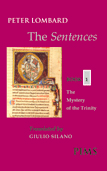
mst42.gifThe Pontifical Institute of Mediaeval Studies in Toronto has just published Book 1 of Peter Lombard’s Libri sententiarum in English translation by Giulio Silano. Here is the blurb:

PETER LOMBARD
The Sentences – Book 1: The Mystery of the Trinity
Mediaeval Sources in Translation 42. St Michael’s College Mediaeval Translations. 2007. • lviii, 278 pp.
ISBN 13: 978–0–88844–292–5 (ISBN 10: 0–88844–292–0) • $39.95


This volume makes available for the first time in English a full translation of Book 1 of Peter Lombard’s Sentences, the work that would win the greatest teacher of the twelfth century a place in Dante’s Paradise and would continue to excite generations of students well beyond the Middle Ages.

You can see a PDF ad for the book, download a PDF order form for it, or learn more about it and PIMS’s website.

Comment

Mark Johnson

Mark Johnson is an associate professor of Theology at Marquette University, and founded thomistica.net on Squarespace in November of 2004. He studied with James Weisheipl, Leonard Boyle, Walter Principe, and Lawrence Dewan, at the Pontifical Institute of Mediaeval Studies (Toronto, Canada).

The journal, Medieval Philosophy and Theology, is on-line only

The journal, Medieval Philosophy and Theology, which began in 1991 at Notre Dame University but has since moved to Cornell University, has changed from being a printed journal to an on-line only journal. Here is the journal's general description of itself:

Medieval Philosophy and Theology is a semi-annual, peer-reviewed journal devoted to the publication of original articles in all areas of medieval philosophy, including logic and natural science, and in medieval theology, including Christian, Jewish, and Islamic. Coverage extends from the Patristic period through the Neo-Scholasticism of the seventeenth century.

…[b]eginning with volume 12 the journal will be publishing new issues exclusively [on-line], exclusively in digital format. All back issues of the journal are also accessible…in digital format.

The finely-wrought website has a search feature, and currently sports all the articles from volumes 1–6 in PDF format, with the hope that volumes 7–11 will be available soon.

Comment

Mark Johnson

Mark Johnson is an associate professor of Theology at Marquette University, and founded thomistica.net on Squarespace in November of 2004. He studied with James Weisheipl, Leonard Boyle, Walter Principe, and Lawrence Dewan, at the Pontifical Institute of Mediaeval Studies (Toronto, Canada).

New English translation of the Summa theologiae in progress

Dr. Alfred J. Freddoso of Notre Dame, whose personal website is already a source of seemingly infinite learning, has embarked upon a new English translation of the Summa theologiae, which he hopes to publish with St. Augustine's Press before too, too long. In the interim he has taken to placing PDF versions of individual questions on-line as soon as he has them in "penultimate draft" form. As of this writing he has most of the Prima pars done, and chunks of the Prima secundae. Check it out, and don't forget his helpful commentaries, too.

Comment

Mark Johnson

Mark Johnson is an associate professor of Theology at Marquette University, and founded thomistica.net on Squarespace in November of 2004. He studied with James Weisheipl, Leonard Boyle, Walter Principe, and Lawrence Dewan, at the Pontifical Institute of Mediaeval Studies (Toronto, Canada).