Reviewed by Fr. Van Khanh Tran, The Catholic University of America
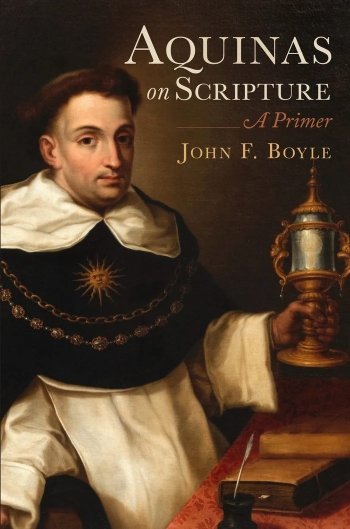
Boyle, John F. Aquinas on Scripture: A Primer. Steubenville, OH: Emmaus Academic, 2023. 138 pages.
In Aquinas on Scripture: A Primer, John Boyle, an expert on St. Thomas Aquinas, offers not merely a general introduction to how St. Thomas read and understood Sacred Scripture, but an essential tool for approaching his commentaries. Boyle identifies the problem that St. Thomas says little in a systematic way about interpreting Scripture. He simply sets about reading it and presumes much of his readers’ understanding, a habit that leaves many modern readers frustrated and confused (3). In response, Boyle’s goal is to build a bridge between St. Thomas and modern readers by articulating concepts and categories that St. Thomas himself never explained systematically.
To accomplish this task, a three-part structure serves Boyle’s initial intention to “enter the mind of St. Thomas, to understand his language and his lines of thought” (2). Because one cannot understand an author whose assumptions remain hidden, Boyle begins (Chapter 1) by reconstructing the presumptions St. Thomas makes about what his readers already know, particularly concerning the senses of Scripture. He then introduces the “causes” that lie at the heart of St. Thomas’s thinking (Chapter 2), which may at first seem strange to modern readers but reveal how St. Thomas reasons. From these causes, the four remaining chapters (3–6) develop a sustained four-cause analysis, so that the reader gradually acquires the very framework St. Thomas takes for granted. In this way, the progression moves from what is presumed to the principles behind it to their full application, with each step bringing the modern reader closer to reading St. Thomas “fruitfully and with joy” and, better still, to reading Scripture itself with the same fruitfulness and joy (3).
The first chapter recovers the assumptions a modern reader needs in order to understand St. Thomas. Boyle begins with his theory of language: words signify ideas, and the commentator must attend to an author’s words, sentences, and coherent thought (5–8). Most distinctively, the literal sense is not simply “what the author meant” but what the words signify (15). Because God is Scripture’s ultimate author, a passage may therefore admit multiple literal meanings. Boyle then explains the mystical senses, allegorical, tropological, and anagogical, while insisting that they rest on the literal sense. This grounding guards against the danger that readers “simply read into Scripture what they want” (30).
The second chapter introduces the four causes that organize the book: formal, material, efficient, and final. Rather than presenting these as abstract metaphysical categories, Boyle recasts them as ordinary ways of understanding things (39–42). Since created things can be understood through their causes, this framework offers a reliable approach to Scripture. Following Aristotle, Boyle emphasizes that wisdom consists in knowing things through their causes and, ultimately, in understanding them in their highest cause and first principle, God. The remaining chapters show how St. Thomas applies this framework to biblical interpretation.
The third chapter examines the final cause, or end, of Scripture: salvation. Scripture makes known the truth necessary for salvation, disposes readers to grace, and directs them toward eternal life (47). Hence, it is “first and foremost about salvation” (49). Boyle also shows how St. Thomas identifies the particular end of each biblical book through the verse cited in its prologue: Isaiah directs readers toward faith, love, and perseverance, while the Psalms unite the soul to God in prayer. Authorial intention is likewise understood in relation to an action’s end, not as merely subjective meaning. The commentator must therefore articulate both divine intention and the human author’s participation in it, even when a passage allows more than one legitimate interpretation.
The fourth chapter treats the efficient cause: the author. Scripture has dual authorship, since God is its principal author while human writers are genuine causes who serve as fitting instruments: “God writes with men” (65–67). Boyle illustrates this through St. Thomas’s accounts of Isaiah, Jeremiah, John, and Paul, each suited to his scriptural task in a distinctive way (68–75). He then extends the discussion to the Church’s commentators, whose work continues the explanation of Scripture through the Holy Spirit. St. Thomas distinguishes the necessary authority of prophets and apostles from the probable authority of other holy teachers. Although St. Thomas may disagree in some cases with other holy teachers’ interpretations, he recognizes that his own work, like theirs, participates in the Church’s communication of saving divine wisdom.
The fifth chapter considers the material cause: what a biblical book contains and how its content is organized according to its end and the author’s intention. Boyle’s central focus is the medieval practice of dividing a text to reveal its conceptual unity. Such division is not merely an outline but a substantive commentary, because “the part is always in relation to the whole, and the whole in relation to its parts” (86). Readers must therefore interpret individual passages within the structure of the whole book. Boyle illustrates this with the Gospel of John, the Pauline letters, and St. Thomas’s account of Scripture as a whole (89–97), including his practice of comparing passages across biblical books to illuminate a common theme.
The sixth chapter addresses the formal cause, which St. Thomas calls “modus” and Boyle explains in terms of genre, style, and literary technique (111–12). Form matters because it shapes how a text’s argument should be understood. St. Thomas reads Job as a dispute about the suffering of the just and divine providence, and he treats Paul’s letters not merely as correspondence but as arguments (114–17). Losing sight of this argumentative structure makes the commentary difficult to follow. Accordingly, when St. Thomas identifies what Paul intends, he often points to the conclusion that clarifies the meaning of the words (118). Since theology itself reasons from revealed truths to further conclusions, literary form and theological method converge. The four causes together provide an ordered approach to St. Thomas’s commentaries.
Judged by its own aims, the book largely succeeds. Its four-cause structure proves a genuine instrument, not a tidy arrangement. By walking the reader through end, author, matter, and form, Boyle assembles the equipment St. Thomas presumes but never lays out. Chapter 5 is the clearest proof, showing that the division of the text is itself a substantive commentary. Boyle hands the reader a key without which one “readily gets lost” (117). The further aim that readers come to read Scripture itself with joy is met only indirectly, through the transfer of St. Thomas’s approach to the reader. This is a deliberate boundary, not a failure. For readers familiar with the historical-critical method who encounter St. Thomas’s commentaries for the first time, Boyle’s account is striking precisely because it treats Scripture as an inexhaustible treasure rather than an object to be dissected, inviting them to discover dimensions of the biblical texts that a purely historical-critical approach may not fully disclose.
What I found most valuable was not the analytic machinery but the vision underneath it. Boyle’s recovery of St. Thomas as a faithful reader, one who reads with an affection deepened in the study of Scripture, reframes the whole task of interpreting Scripture as an act of faith and love rather than technique. It is easy to treat the medieval senses of Scripture as a technical curiosity. Boyle instead shows them ordered to a reading that “illuminates reality in the light of divine truth” (33), the vision belonging not to St. Thomas alone but to the Church. For a reader who might otherwise approach Aquinas as a set of techniques, this is genuine reorientation, and the book’s quiet strength.
My one reservation concerns the bridge to modern scholarship. Boyle does not ignore it. He insists that much in it would delight St. Thomas, who would know how to situate it within an ordered whole (138), but this remains an assertion rather than a demonstration. As a graduate student trained partly in historical-critical method, I finished the book persuaded of St. Thomas’s coherence on his own terms yet still unsure how his reading and mine are to meet. A single worked example, St. Thomas’s reading of a particular passage set beside a modern historical-critical reading of the same text, showing how the two might illuminate each other, would have demonstrated, rather than promised, that compatibility. Even so, this is the natural horizon of a “primer” rather than a flaw. Boyle’s tone throughout is confident but never combative, willing to name real dangers that mystical reading risks letting readers “read into Scripture what they want” (30), without defensiveness or triumphalism. I would readily recommend it, especially to anyone opening a Thomistic commentary for the first time. It would be particularly valuable for pastors who want to understand St. Thomas’s approach to Scripture and his affection for it, an affection nourished by Scripture itself and expressed in the way pastors can nurture others through their homilies. The book does not tell them everything, but it teaches them how to begin reading well and with joy. On its own terms, that is success.